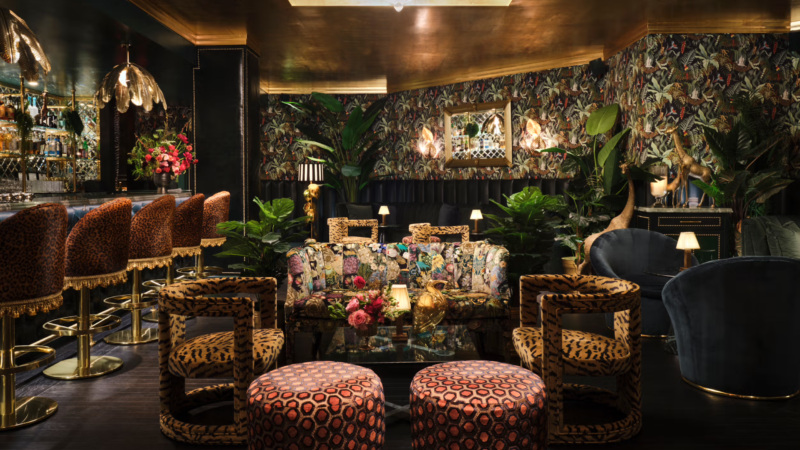
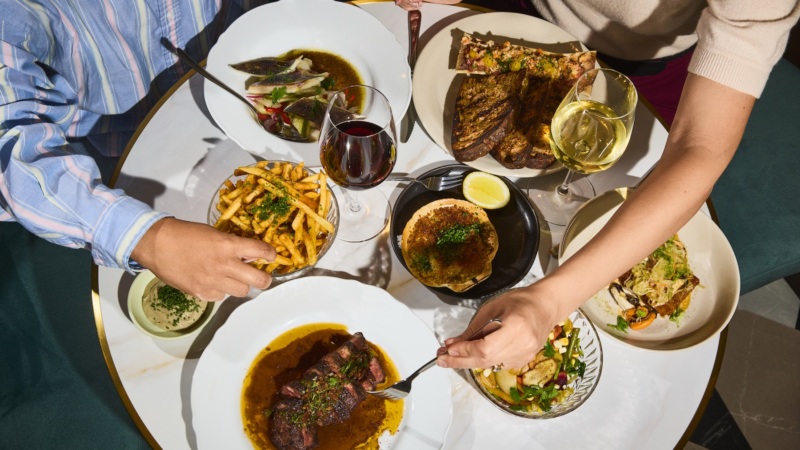
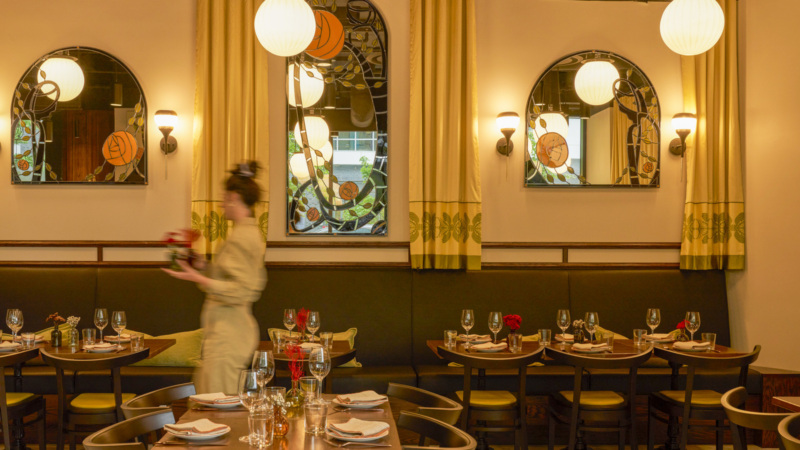
Behold, the newly remodeled dining room.

1. The rebuild was years in the making.

The design, which preempted the food concept, was a collaboration between Wang, Carolyn Baylon of Carolyn Baylon Design Studio, John Barlow at Lightspeed Design, and William Beautner of Make Architecture. The low-ceilinged space, which formerly housed Pok Pok, underwent a major remodel, notably by downsizing the kitchen and increasing the dining space, and adding more doors to accentuate the cozy feel. 

The result is a warm, sage-green tiled interior with wooden trim in the doorways to match the furniture. “I played around this idea of East meets West,” says Wang. “And Shanghai was ultimately a place that I settled on as a huge inspiration: walking along the Bund and seeing a backdrop of Chinese traditionalism, but also European midcentury to early 19th century architecture. It became this hybrid, making it feel subtly Chinese while retaining the spirit of a French brasserie.”

“Steak tartare with the flavors of mapo tofu.”

2. The dishes are born of Wang’s memories growing up.

Though there’s a story behind each dish, don’t expect a list of Chinese staples. Rather, Wang creatively spins snippets of his own nostalgic food memories into entirely new ideas. 

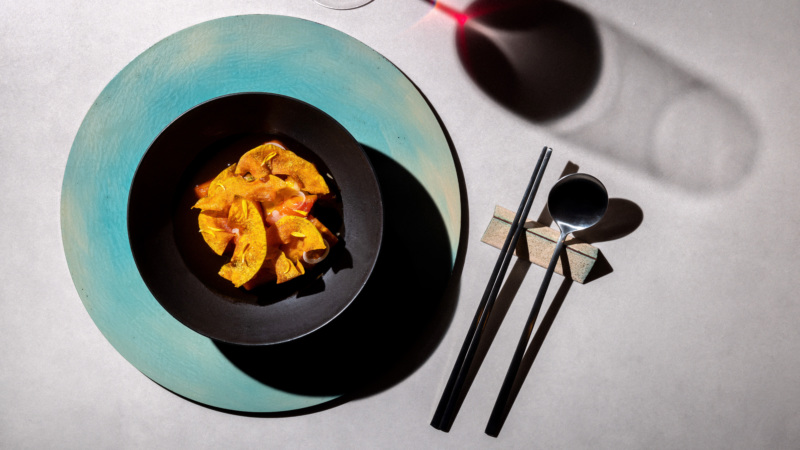
The mapo tofu tartare, for example, is inspired by Wang’s preference for morning-after mapo tofu leftovers, scraped of the solidified fat that forms overnight. To create a similarly lean version of the dish, Wang uses black mission figs, black and sherry vinegar, doubanjiang paste, and Shaoxing wine to bring a subtle sweetness to the contrasting cold tofu with room temperature beef.

Fried Chongqing chicken is less spicy than it looks.

The BBQ cabbage is an homage to Wang’s mother’s cooking. “Being in a Chinese immigrant household and having a great cook as a mother, I think, What a hero, because she found ways to feed the family with a very limited amount of meat and a lot of vegetables,” he says. In his version, Wang slow-roasts cabbage and presses the leaves with alternating layers of leeks cooked in butter, then cuts them into pavés, broils them, and serves the finished product in a sauce made from burnt onion reduction, Chinese black vinegar, soy, and green allium oil. 

Fried Chongqing chicken lifts from the original stir-fried Sichuan version, which relies on chiles to contribute a moderate dose of aroma and spice. “We didn’t want the fried chicken to feel like a challenge; we just want it to be delicious,” says Wang. “And it tells this really beautiful story of, again, East meets West, because chiles aren’t indigenous to China.” The dish, which looks spicier than it tastes, has a crunchy-yet-airy texture that gives way to juicy, flavorful meat. 

Kenzo Han is behind the creative cocktails.

3. Don’t miss out on the cocktails …

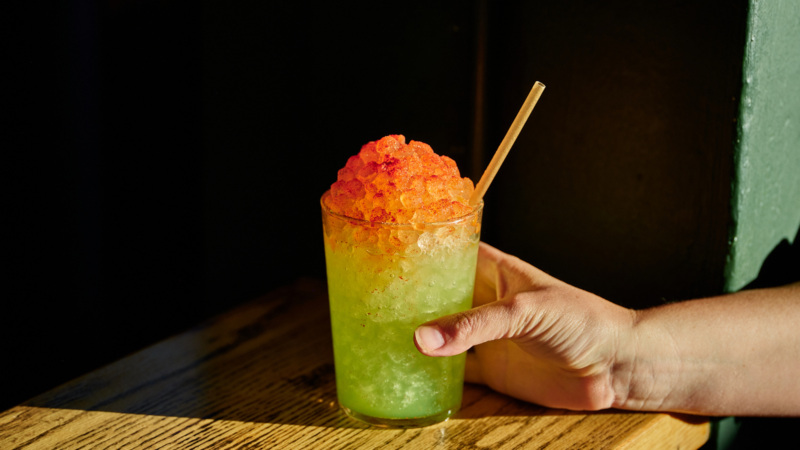
Kenzo Han helms the bar program and is as into storytelling as Wang. Wang’s personal favorite is Han’s sobacha bourbon fizz, where the maltiness of buckwheat tea adds another element to the fluffy whiskey sour. Of course, there’s also baiju, found in the Negroni, balanced despite incorporating overproof rum. In it, green Mandarin pu-erh tea and Smith & Cross rum factor in with Campari, Cocchi Di Torino, and lime, putting a tea-infused spin on the classic while showcasing the floral notes of the Chinese spirit. 

The dozen signature drinks and four spins on classics listed as “staff favorites” are accompanied by a trio of non-alcoholic options which stand on their own rather than using substitutes. Hojicha is combined with orange cordial, dark chocolate, and clarified with yogurt for a milk punch that is as tasty as it is complex. Lacto-fermented blueberries are infused into Seedlip Grove spirit and shaken with lemon and egg white, and topped with soda for a fizz. The selection of wines is trim but global, with all bottles also available by the glass.

Chamomile custard with green apple, cucumber, and kinako shortbread.

4. …or the desserts.

Pastry chef Jaime Craten honed his craft under chef Jordan Kahn at Vespertine, Destroyer, and Meteora. He has created three desserts that draw from the influences of a traditional Chinese banquet to maintain cohesion with Wang’s menu. Almond tofu, a vibrant green apple and cucumber-infused chamomile custard with kinako shortbread, and a strawberry castella cake with lemongrass cream are on the opening menu, each incorporating savory notes to meet Wang’s request that no dessert feel “too sweet.” Pastel colorways on the plate provide a pretty canvas to familiar Asian dessert flavors and ingredients, such as almond, lemongrass, and chamomile, while pops of jujube and osmanthus keep things visually and textually interesting.

5. The decision to open in Chinatown was deliberate.

Wang met with Mandarin Plaza owners Martin and Scott Lee to discuss what the community needed and what the plaza could use in the space. He also thought about what he could add to the neighborhood within the context of Chinatown’s legacy. “I think it’s such a fun neighborhood to be in — there are so many different businesses for everybody. It becomes an urban street that you can make an evening out of — not just by eating at our restaurant, but also by walking around and seeing the beautiful architecture and the history,” Wang says. “It really makes you feel as though there’s a sense of place.” 

Firstborn is a heartfelt tribute to Wang’s own diasporic culinary journey. With a restaurant to finally call his own, he’s incorporating his own perspectives in New American cuisine, right in the heart of Chinatown.

Esther Tseng is a food, drinks, and culture writer. She has contributed to The Los Angeles Times, Eater, Food & Wine, Civil Eats, and more. Follow her on Twitter and Instagram. Follow Resy, too.

Recent Posts


The RundownLos Angeles

Firstborn is a Perfect Addition to Chinatown’s Mandarin Plaza

Anthony Wang’s Chinatown bistro is a highly personal venture, reflecting Wang’s journey as the first in his Chinese immigrant family to be born in America.

By

Tam Pham of Tâm Tâm

Dream Team DinnersMiami

Kwame Onwuachi Showed Me the Rewards of Being Unapologetically Yourself

Tâm Tâm chef Tam Pham reflects on how watching Kwame Onwuachi stay true to himself and his beliefs — and be successful — inspired him.

By

Aaron Lindell and Hannah Ziskin of Quarter Sheets

Dream Team DinnersLos Angeles

Jacques Pépin’s Influence Was There All Along

After growing up watching his cooking shows, Quarter Sheets chef Aaron Lindell realizes that Jacques Pépin’s influence was there all along.

By

Masako Morishita of Perry's

Dream Team DinnersWashington D.C.

My Mother Taught Me Everything I Know

For Perry’s chef Masako Morishita, it all began when her mother Ryoko taught her how to fold gyoza at her family’s tiny restaurant in Kobe, Japan.

By

Chris Jung of Maxwells Trading

Dream Team DinnersChicago

How Sean Brock Helped Me Find My Culinary Identity

For Maxwells Trading chef Chris Jung and a generation of cooks, Sean Brock’s “Mind of a Chef” episodes defined what it meant to cook as an American.

By

Yara Herrera of Hellbender

Dream Team DinnersNew York

What Martha Stewart Taught Me About Success

Hellbender chef Yara Herrera on how Martha Stewart inspires her all-encompassing understanding of what it means to deliver hospitality.

By

Sam Yoo of Golden HOF and NY Kimchi

Dream Team DinnersNew York

Why I’ll Never Forget a Questlove DJ Set

How watching Questlove perform 10 years ago inspired chef Sam Yoo to give it his all.

By

GuidesLos Angeles

The Resy Guide to Outdoor Dining in Los Angeles

For many Angelenos, al fresco has long been the preferred way to dine. Between the fresh air, warm weather, and…

By and Updated:

The RundownNew York

There’s a New Fish Cheeks in Town

With a new second location in Williamsburg, the Fish Cheeks team hopes to bring their signature magic and thrilling Thai cooking to Brooklyn.

By

More Stories