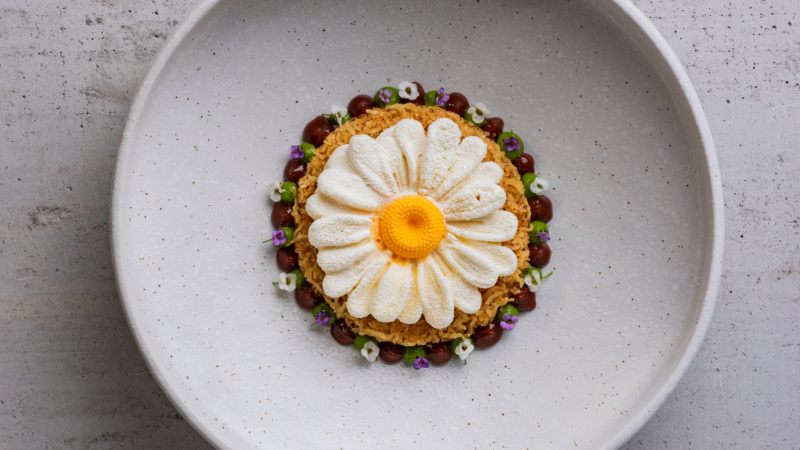
1. Maison Sun is the collaborative effort of a small (but mighty) team.
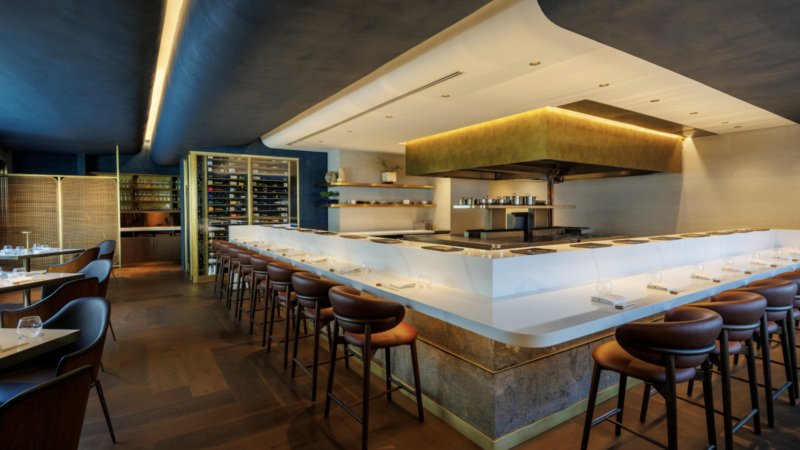
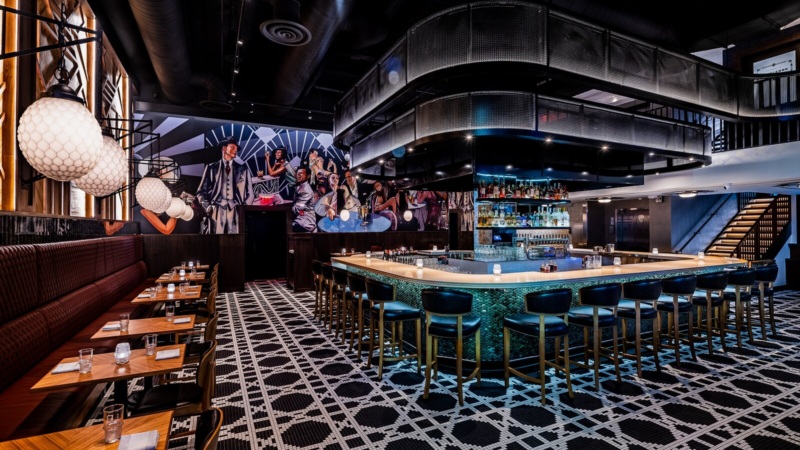
With only eight seats available at this chef’s counter, Maison Sun offers an intimate night out with Gasperi attending to guests, chef Nguyen overseeing the kitchen, and John Wing, the restaurant’s porter of three years, providing additional support.
“It’s a vision-driven restaurant, not ego-driven or chef-driven. That’s also what makes us different from a lot of tasting counters in New York where it’s a single person’s final say,” says Gasperi.
“For us, it’s more about a collaborative vision between myself and chef Nguyen, and something that aligns with the greater vision, which is the restaurant as a whole,” continues Gasperi. “John is also very much a participant in the experience and in the menu to a degree, too. It’s a very family kind of vibe we have going on, which is beautiful, and I’m very proud of.”
2. Chef Nguyen’s heritage and skills shine through Vietnamese flavors and French technique.
With phở as the family business, chef Nguyen’s childhood included hearing stories of her dad working in his mother’s phở place back in the former village of Mỹ Tho, Vietnam.
Growing up in a household where food was a serious family matter, Nguyen started cooking at eight years old and eventually made her way to the Culinary Institute of America and Eleven Madison Park. Around the same time, she also launched Beaucoup NYC, a Vietnamese culinary concept that made its mark during the pandemic with a series of pop-ups throughout Brooklyn.
Now, at Maison Sun, Nguyen’s goal is to celebrate “the French influence on Vietnamese cooking,” she says.
“The menu is an intentional connection that I feel is necessary between French and Vietnamese cuisine,” she continues. “There’s always a disconnect between the two in restaurants today. Many focus on the Vietnamese authenticity, but not a lot [of restaurants] understand the large range of our dishes and where they come from.”
3. Historic trade routes bridge boundless inspiration with modernity.
Gasperi believes that all great restaurants must have a source of imagination with a unique voice and stance. “And I found that in the Silk Road,” he says. “It gives a perspective to the historical trajectory of the grounds in which we stand in Brooklyn.”
What he finds especially fascinating about historic trade routes are how they once bridged ancient wisdom and goods that simply existed in nature — and brought them into modernity.
“Things at one point in time are avant-garde. Then they become ancient and then avant-garde again. Those kinds of loops are how it all comes together,” he says.
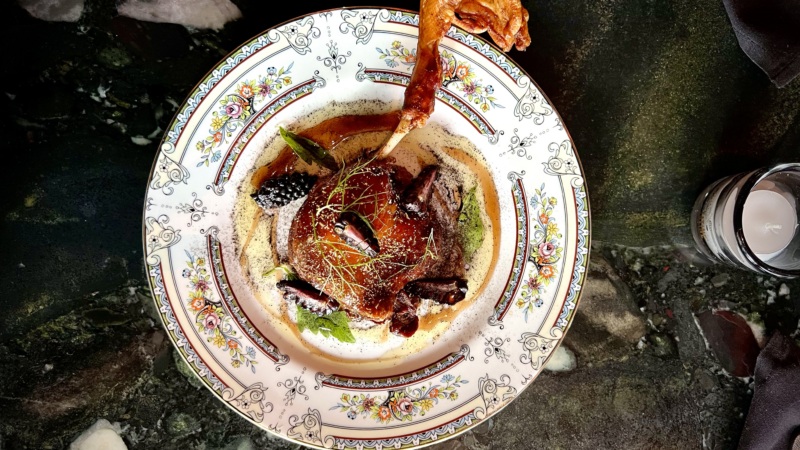
For example, star anise is crucial to Vietnamese cuisine and was a major trade item along the Silk Road. The spice is also a vital component in one of Maison Sun’s signature dishes: the dry-aged duck phở with star anise duck consommé.
“We’ve taken the phở and made it into something quite refined,” Gasperi notes. “We smoke it with pear wood from the Hudson Valley, use Khaki Campbell wild duck, then handmade rice noodles, German and French porcelain, and French silver for the cutlery and silver chopsticks. It’s that combination of comfort and high-end, comfort and luxury, and timeless dishes that come from ancient traditions combined with modernity. And that right there, is the Silk Road.”
4. Expect new interpretations of Vietnamese flavors.
While the nine-course tasting menu is set to change seasonally, there are a few things diners can expect year-round.
“The menu is really an intentional effort to elevate Vietnamese cuisine by using fresh, high quality, ingredients, and taking each dish out of its traditional execution,” says Nguyen. “Our fish is never frozen, and the use of fresh fish in Vietnamese cooking is definitely something I highlight,” she adds.
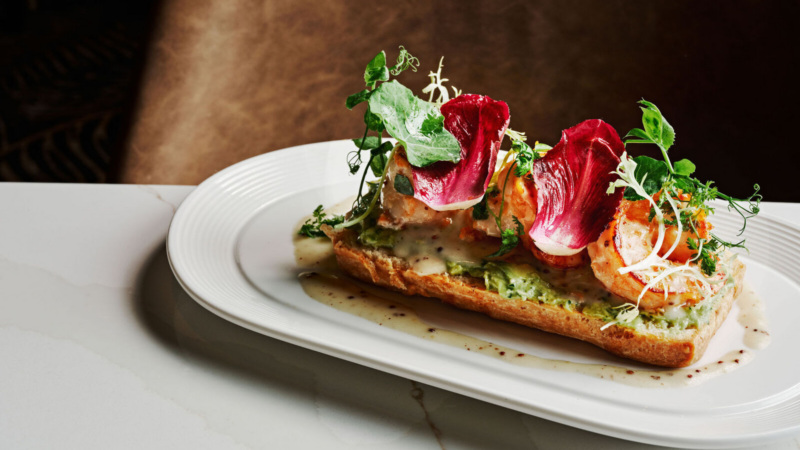
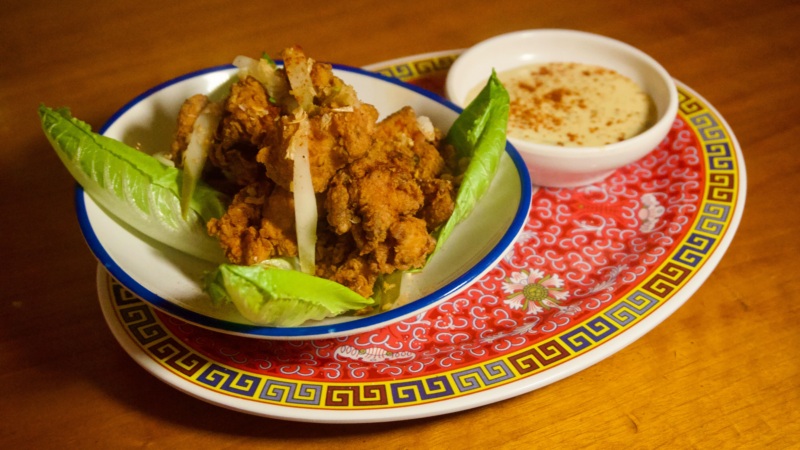
When it comes to signatures dishes that are expected to remain menu staples, there are two: The dry-aged Khaki Campbell duck phở and Hawaiian head-on shrimp mochi.
While most Vietnamese restaurants use beef or chicken for their phở base, Maison Sun uses duck — and more specifically, it’s a wild species with a much gamier essence that originated in Gloucestershire, England.
Similar to Nguyen’s unique phở, the mochi is an item that’s not often seen in professional Vietnamese kitchens. “Our menu aims to educate people and bring awareness to Vietnamese dishes they’ve never had before. Even for New Yorkers who’ve been here [for] years, it’s the first time that most people have tried this,” says Nguyen about her mochi dish.
Named bánh ít ram in Vietnamese, the dish is traditionally a dumpling with a soft, chewy exterior served atop a crispy pancake. Chef Nguyen’s delicate offering includes two types of dough, a crispy rice dough and mochi dough, the latter of which is made fresh and is then presented in a mini bamboo steamer.
“It’s similar to when summer rolls sit around, it gets hard and you can’t eat it anymore,” she explains. “The mochi dough has to be made on the spot. It’s meticulous and the extreme attention to detail has to be there.
“The place where this particular mochi dish makes sense is here in fine-dining, rather than a high-volume Vietnamese restaurant,” she adds.
5. The Hudson Valley’s various micro-terroirs are present across the menu.
“It’s something I take very much to heart,” says Gasperi on the topic of him heading to the Hudson Valley regularly to explore its farms.
“I’m very keen on sourcing ingredients from the Hudson Valley and exploring the region’s various micro-terroirs. This gives the restaurant, more than anything, authenticity, and an expression of a concept I like to think of as grounded-ness.
“When a restaurant is really rooted and grounded in its community and in its place, it has, to a degree, an obligation to pay its respect to nature and seasonality,” he adds.
For him, that means sourcing everything from the pear wood used to smoke the duck in the restaurant’s signature phở, to the wild grains used across the menu, which led him to Wild Hive Farm in the Dutchess County hamlet of Clinton Corners.
“Wild Hive Farm is fascinating,” says Gasperi. “The owner has been developing strands of wheats and grains independently for decades. They exemplify our respect and appreciation for the local terroirs.”
6. The beverage program spotlights French and German wines.
“I know most of the producers on a first name basis, or if not, I’ve been to the vineyards. I’m very keen on proximity and respect for the winemakers,” says Dr. Gasperi as he shares the beverage program’s particular focus on French and German wines.
Specifically, his curation gravitates towards the winemaking regions of Burgundy, France, and Mosel, Germany, along with Tokaj, Hungary.
But it’s a wine producer’s philosophy that appeals to Gasperi the most, such as Armand Heitz’s, who fosters a terrestrial approach with a deep appreciation for the land. “His policy very much aligns with mine in this respect: His family has been making wine since the early 1700s and they’ve acquired a sizable amount of land. But what’s relevant is the way they handle the land. They cultivate beehives, grow vegetables, raise cattle, and all of the waste that comes from this land is used to nourish the vineyards.”
“What’s nice about this self-sustaining ecosystem is that it produces wines that capture that rustic countryside charm of Burgundian France,” he continues.
Along with wines by the glass and several non-alcoholic varietals, Maison Sun offers a standard wine pairing for $150 and a reserve option for $300.
Maison Sun is open from Wednesday to Sunday with nightly seatings at 5:30 and 8 p.m.
Tae Yoon is a writer and a former contributing editor at Resy. His more than 15-year career in the New York City food and restaurant industry includes restaurants, bars, marketing, events, and food journalism both as a writer and editor. He’s currently writing a futuristic novel about revenge and food. Follow him on Instagram and TikTok.