Dada Echo Park is Your Night-Out Destination for Food, Drinks, and Dancing
Published:
It’s not easy to define Dada Echo Park, an ever-evolving, music-centric restaurant and bar that’s unlike anywhere else in Los Angeles at the moment.
From the get-go, there’s an air of mystery: Guests enter through a nondescript space hidden in a back alley behind its street-facing counterpart, Dada Market — an amalgamation of a superette, coffee shop, and permanent home to fried fish sandwich-slinging pop-up Little Fish. Around the back, there’s a full-service bar and restaurant, which can easily unfold on weekends into a dance party once the DJs settle in.
“Once you’re in, you understand what we have, but it’s a lot [to take in],” says Dominic Müller, who operates the Dada complex with his business partner, Christine Tufenkian.
In some ways, Dada mirrors the movement — one that redefined modern art in the early 1900s through the works of Marcel Duchamp and Man Ray, among others — that Müller named the complex after. The group behind this Dada is composed of creatives in the art, production, music, and food and beverage worlds. It’s Müller’s, who was formerly an art director and currently heads his own commercial production agency Acre Creative, first foray into the culinary scene.
“I’m learning about restaurants for the first time in my life, plus, I’m also running another full company,” Müller says. “I have a coaching team that’s helping me through it.”
MORE FROM RESY
Müller’s connections, perhaps unsurprisingly, stem from his artistic endeavors. He met Tufenkian, a producer who previously co-owned the Silver Lake restaurant Cafe Stella, 15 years ago on a shoot. Müller befriended Dada’s creative director, Jeff Fribourg — a multi-disciplinary artist who’s played in bands, opened record stores, and worked in Paris as a music curator and graphic designer for luxury fashion house Celine — through production as well. There’s a piece of everyone in the final product of the singular Dada Echo Park, which opened in March of this year, just three months after the market launched.
Like we said — there’s a lot to take in here. So we caught up with the Dada crew to get the rundown on everything you need to know before you go.


1. The wood-fire-kissed dishes are created by a seasoned chef.
Over his nearly 20-year cooking career, Dada’s executive chef Ramon Morales has experienced the breadth of California cuisine while cooking at popular L.A. restaurants like All Time, Honey Hi, Oriel, Kismet Rotisserie, and Cafe Stella. He used that cumulative knowledge and his cultural background in Guatemala to create a light and refreshing Mediterranean- and Latino-inflected menu for Dada.
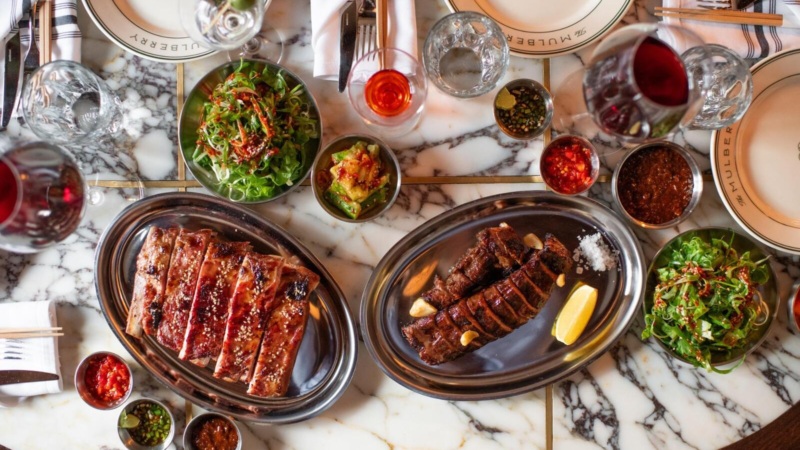
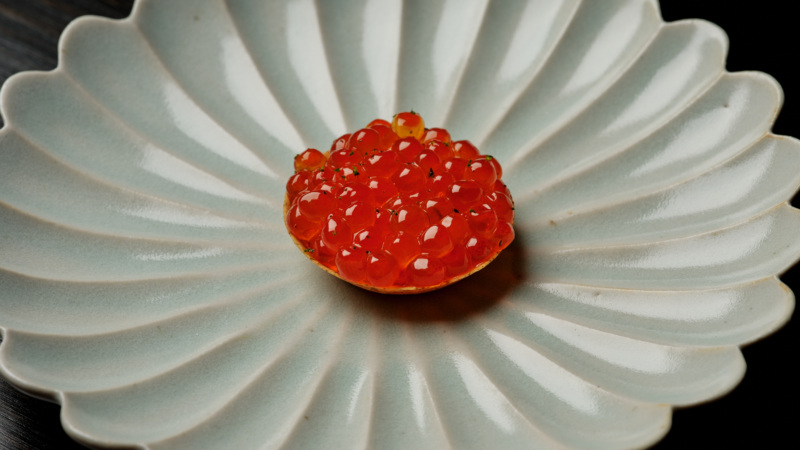
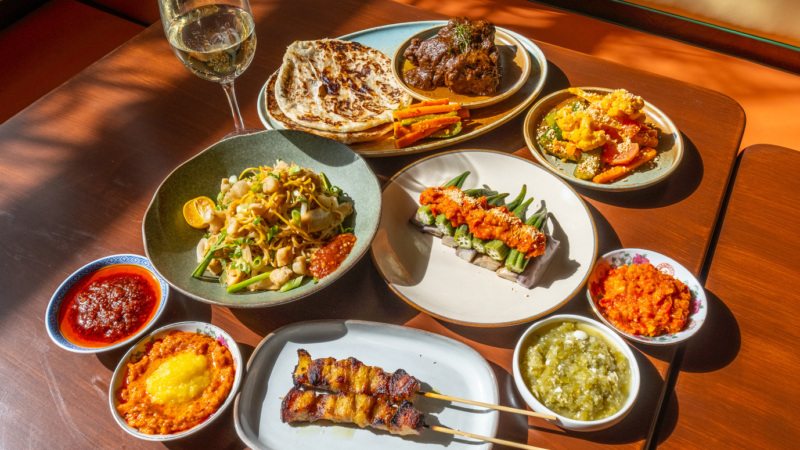
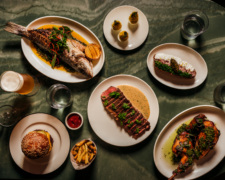
The seasonal produce that Morales hand-picks weekly from Santa Monica Farmers’ Market plays a major role in his colorful dishes. The hamachi crudo is married with cubed stone fruit and adorned with paper-thin slices of serrano peppers. His rainbow vegetable medley of grilled cauliflower, beets, okra, and squash rests on top of a pool of curry carrot romesco sauce. A third of the menu consists of dishes seared over a mesquite and apple wood-burning grill, like charred branzino paired with a salsa verde, and lamb chops marinated with Aleppo pepper and cumin, accompanied by a yogurt tahini sauce and salsa macha. But Morales’ favorite dish is a humble bowl of lima bean soup, an addictive green broth made of parsley, basil, oregano, and lemon juice. It’s served with slices of Bub & Grandma’s bread to sop up all the flavorful juices.
Helming this kitchen has been a long time coming for Morales, who rose up from dishwasher at Cafe Stella to prep cook, and beyond. Expect some French-accented menu additions as the weather cools and calls for richer flavors; along with year-round vegan, gluten-free, and nut-free options. “When I create a menu, I want everybody to have a good experience,” he says.


2. The inventive cocktails incorporate housemade tea-infused spirits.
When Dada’s head bartender, who goes by Carmen P., created the drinks menu, she wanted to focus on her passions: tea infusions, fresh juices, and seasonal produce. “Being a food lover is my main inspiration,” says Carmen, whose experience includes New York establishments like Mr. Fong’s and Hotel Delmano, as well as L.A.’s Zebulon. “I don’t really think about booze first. I think about the flavors, produce, and products that I like to use.” Take for instance, the Press Pause, a barley Old Fashioned utilizing a favorite Japanese mugicha tea that she’s enjoyed sipping on for years.
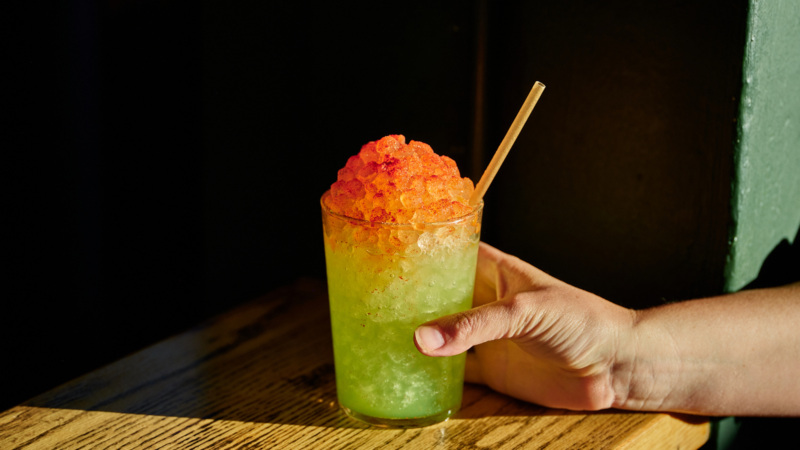
If Carmen’s inspirations are somewhat out of the box, her finished drinks are simple on their surface, to keep them from seeming intimidating. One of her favorites is the Orange Velvet, her take on an orange and carrot gimlet, made with a chamomile-like damiana tea that’s infused with gin, and kicked up with Persian chicory water tonic to add to the carrot’s earthiness. The Very Verde margarita has an extra punch of vegetal flavors with the incorporations of cucumber and lime juice, parsley syrup, and green Chartreuse, all finished with a rim of dill pollen and pink salt.
There’s more to come as Carmen develops the next season’s cocktails. “What we’re working on right now is a dessert drink menu, which is pretty fun, and I think that’ll come into play more in the fall and winter months,” she says.


3. The vibes are underground yet unpretentious.
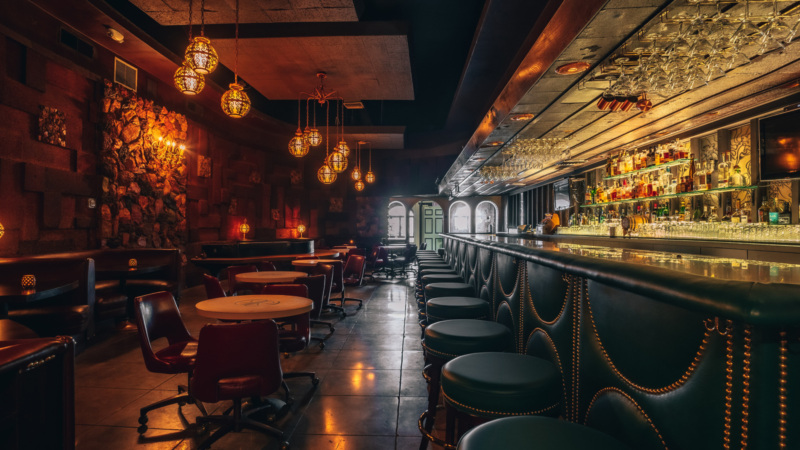
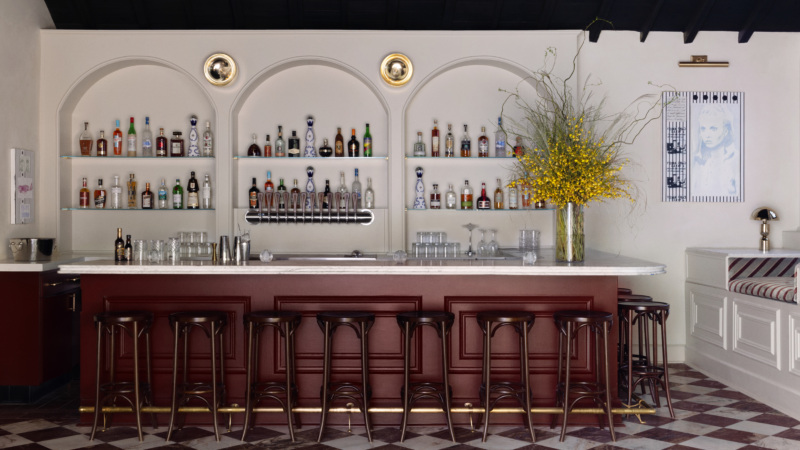
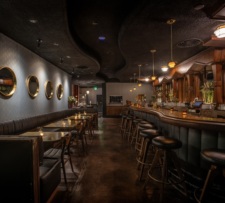
“The thing about Dada is it’s sort of endless,” Müller says. There is a choose-your-own-adventure feel to the full experience of the space. Flanked to the right of the entrance is what Müller calls the pub bar, a moody and dark room with a gorgeous emerald green marbled bar. Behind it is a patio centered by a king palm tree (“the most expensive tree that I’ll ever purchase,” Müller says).
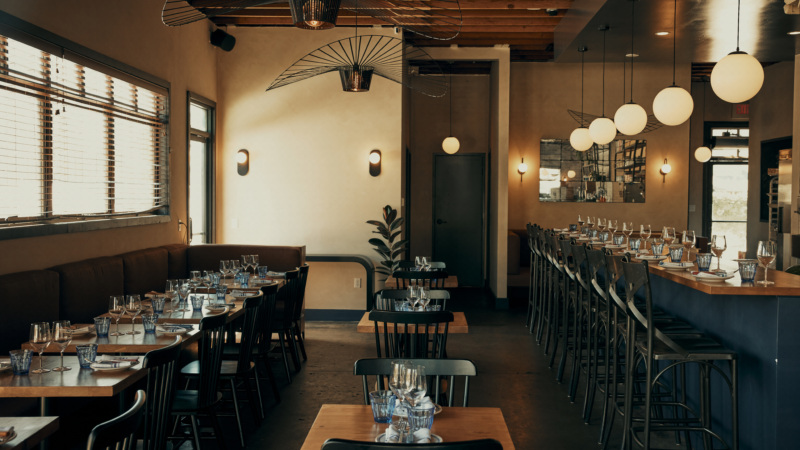
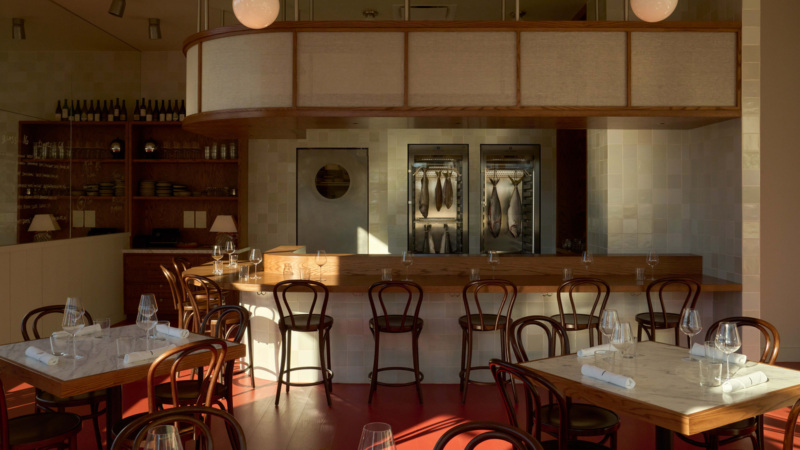
Walk past the pub bar to the back, and the vibe shifts, opening up to a larger space with a second bar to the left, surrounded by light raw oak paneling and a pinkish marbled bar. A prominent hi-fi stereo system and DJ booth serve as centerpieces, a hint of what might unfold later. To the right is the dining area, which is much brighter than any of the other rooms thanks to the expansive skylight and walls lacquered in a muted gray. Diners can also grab bar seating by the kitchen — a chef’s table of sorts, and see the wood-burning grill in action.
“A lot of people come in and never make it to the back, which we think is because the pub bar is so comfortable and cozy,” Müller says. “But if you do go into the dining space, it opens up a completely different feeling.”
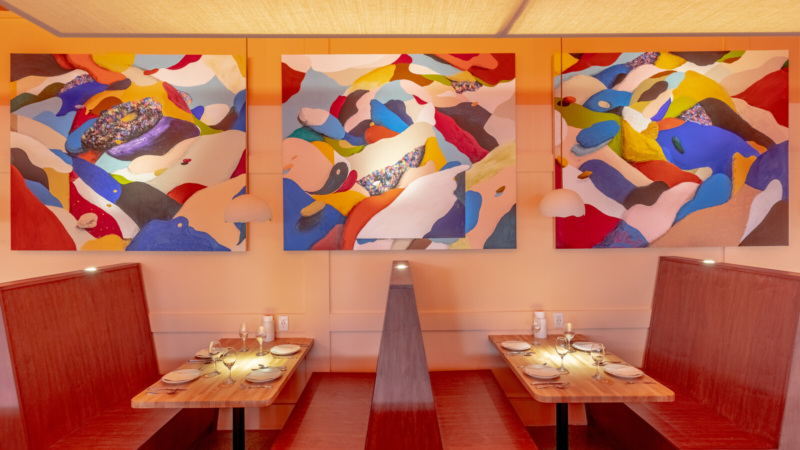
Müller took charge as the interior decorator. He originally wanted art to be the main focus and was in the process of commissioning pieces until he changed his mind and veered toward a more minimalistic design. “It’s less about an art movement and more about honest materials,” Müller says. “And that translates to everything, including the food. I just want anyone to come in here and feel like it’s a creative place for them, and then once you throw in the music, it feels exactly like what I envisioned, which is fun.”


4. Make a trip to the restrooms to see a stunning mirror.
Müller enlisted the help of famous potter and designer Jonathan Entler of Entler Studio to custom-make ceramic lighting — including a chandelier and disco ball — but his favorite piece is a towering, parabola-curved mirror by the restroom. The light gray frame was made from a ceramic mold with interlocking pieces, casting a castle walls-feeling to it.
“It reminded me of going to the Catholic church as a child, getting water as you leave,” Müller says. “So we created a massive sink that looks like that but with this crazy mirror.”
5. Take an artist’s eye in examining and feeling the menu book.
Fribourg is passionate about using a risograph — a digital stencil duplicator known for its vibrant colors, and grainy and textured finish — to print designs for Dada’s menus and DJ night flyers. He takes pride in the eco-conscious, low-energy machine using soy-based ink. Each print naturally comes out differently, which diners can see and feel when they open the menu books.
“It’s so much work, but we really care about every little detail,” says Müller. And this particular risograph has a special history: It was used for L.A.-based noise rock duo No Age’s 2008 Nouns album cover, one which helped them snag a Grammy nomination for the Best Recording Package category.
6. The music is definitely not of the background variety.
When Müller dreamt about Dada, he was influenced by a period in his 20s in Europe, particularly Germany. “There were these restaurants that were all tied together and music was always a part of it. There would be a chef with a turntable and he would just put a record on in between service,” he says.
Dada attempts to recapture some of that vibe with indie rock during dinner that runs the gamut from the familiar to the underground, with artists like Lower Dens and Peter Bjorn and John. While Fribourg helped curate the opening playlists, he says staff choices play a major part in it as well. On Fridays and Saturdays around 10 p.m., DJs — a mix of Müller and Fribourg’s friends and friends of friends — take over the space, playing songs that are mostly electronic with underground pop undertones. Sometimes after a concert at the nearby Echoplex venue, groups will migrate over to Dada Echo Park for more music, bringing in a similar dynamic energy.
When the DJs start, people begin mingling by the oak bar and dining area. “Dancing happens or it doesn’t, but when it does, you’ll see people pushing a table over to the side to make space to dance,” Müller says. “That’s exactly what I want: to feel like we’re not forcing anything.”
Müller’s hope for Dada is that it becomes a community space where different generations — from the dinner to the dance crowds — can commingle. “When you come in, it doesn’t matter where you’re from, what you look like, or what age you are — we got something for you, hopefully,” he says.
Jean Trinh’s food and culture stories have appeared in Los Angeles Times, Food & Wine, and The New York Times. Follow her on Twitter and Instagram. Follow Resy, too.