It’s a Pizza Ranch World, And We’re Just Lucky to Live In It
Published:
Pizza unlocked the glory of ranch dressing for me. Today, I realize that a world without the cooling tang of buttermilk, mayonnaise, and sour cream, dashed with dried dill and alliums, is a world without joy — though as a 12-year-old West Michigan boy, the stuff gave me the ick. But the Mitten State would work its magic soon enough. After a baseball game one day, one of my teammates started to dunk a pepperoni slice from local chain Hungry Howie’s into a small dipping cup of the white gold. I followed his lead (thank you, peer pressure) and was hooked. More than that: From then on, I would see the world through ranch-colored glasses, and pizza was to thank.
This was 1992, the dawn of the pizzeria’s now 30-year relationship with ranch dressing. I’m proud to say that my home state has played a significant role in a movement that today touches all 50 states and has drawn battle lines among pizza purists — even if there’s only one right answer to whether pizza and ranch belong together. While it’s debated whether Michigan is the true home of ranch dressing on pizza (which we’ll call pizza ranch going forward), it’s clear that Michigan was home to pizza-chain innovation in the 1980s and ’90s.
National chains with Michigan origins, like Little Caesars and Domino’s, battled it out with local heroes Buddy’s, Hungry Howie’s, and of course Jet’s, which today operates 450 restaurants in 23 states. In the ’90s, most of the chains were offering a side of dipping ranch with their pizza. But Jet’s saw the future, and starting in the early 2010s sold customers the full bottle, cementing pizza ranch as a legitimate refrigerator door fixture.
Resy Presents
Pizza Nation
- To Become a Pizza Nation? It Took a Village
- Pizza, Perseverance, and the Aloha Spirit: Sale Pepe’s Maui Journey
- Everywhere You Should Be Eating Pizza in New York
- The Ultimate Resy Guide to Outstanding Pizza in Philly
- The Resy Guide to the Best Pizza In Los Angeles (Yes, Los Angeles)
- A Deep Dive Into Miami’s New Pizza Scene
- The Enduring Old-School, New-School Legacy of Rubirosa
- How Del Popolo Became an Essential S.F. Pizza Destination
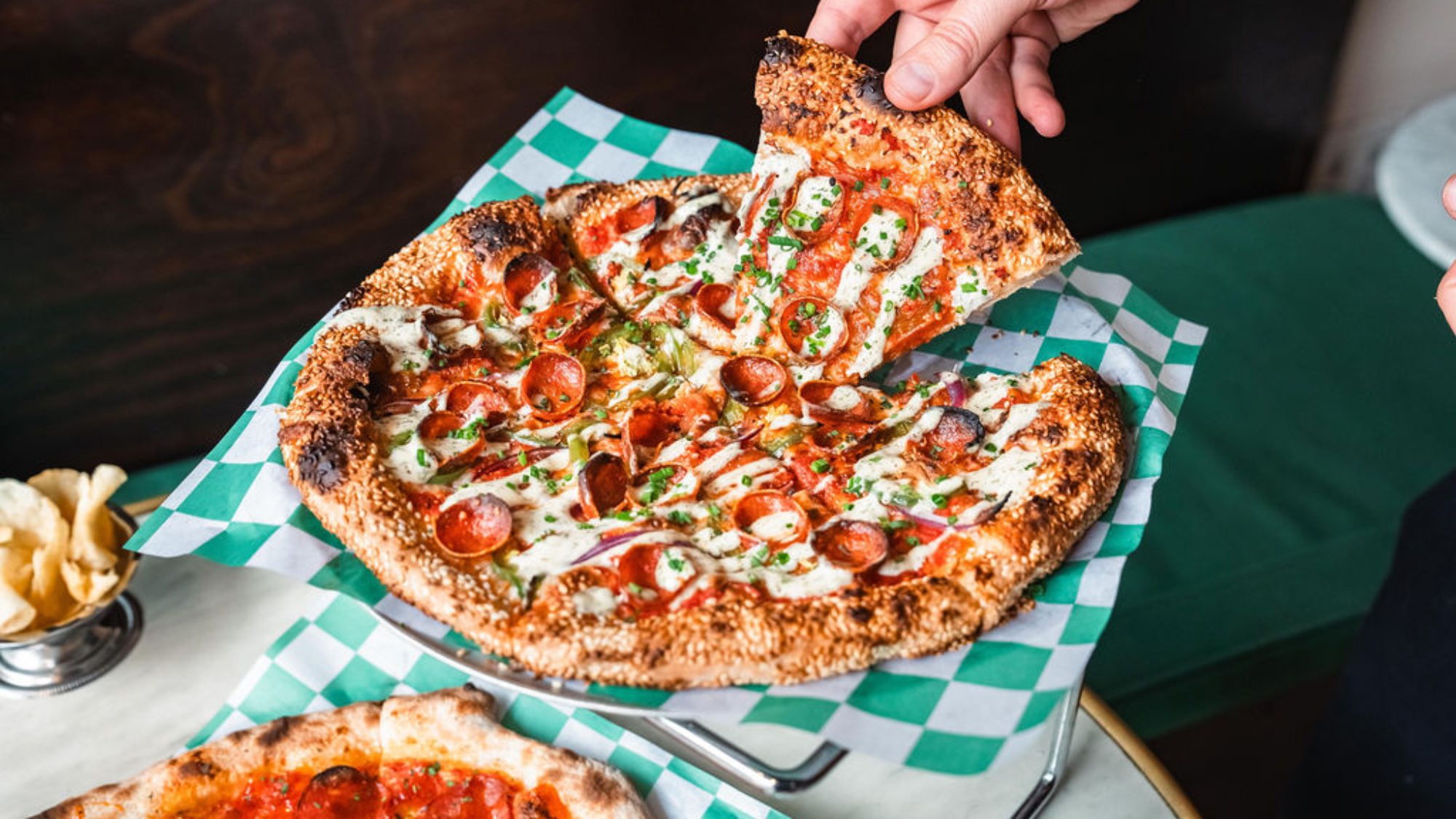
Today you will find ranch in pizza shops across America. At Brooklyn’s Bar Birba, the sesame-crusted pepperoni pie, Don’t Tell Nonna, is topped with a “salsa bianca” (their code for ranch). “I hated this pizza in theory, then said, ‘This is the best pizza I’ve ever had,’” co-owner Matt Diaz told Resy. “I ate it every day for probably two weeks straight.” Emmett’s on Grove, a Chicago tavern-style pizza specialist operating in the West Village, serves its Hot Papi with pepperoni, jalapeño, red onion, and a happy amount of paprika ranch. At Austin’s Via 313 pizzeria, ranch appears in four places on the menu, including on its Funkadelic Chicken (gorgonzola, bacon, red onion, ranch drizzle) and its popular Big Dill (dill pickles, provolone, bacon, dill ranch).
But it wasn’t until I started checking up on the current state of pizza ranch that I fully understood something: The experience I had when I was 12 in a strip mall in Kalamazoo, Mich., was the start of a global culinary revolution.
Emily and Matt Hyland are the cofounders of Emily and Emmy Squared, the Detroit-style pizza empire operating 26 locations around the United States that has done more than any other operator to insert ranch into the serious pizza conversation. “Ranch and pizza are the reason I dip my French fries in mayo instead of ketchup,” Matt says with a smile, noting the condiment tradition long held in Europe, particularly Belgium. The culinary logic is sound. There’s acid from the tomatoes, there’s starch from the crust, and the pizza is steaming hot. The ranch works to cool a cheesy slice — a beautiful contrast of temperatures like a warm Levain Bakery cookie dunked in cold milk — while balancing perfectly with the tartness of tomato sauce.
Flavor-wise, there’s no competition, either. Ranch is sour, with a kick from chives and onion powder. Mozzarella cheese and pepperoni cups, specifically, are singular, with ranch serving as an accent that doesn’t overpower them. Dip a slice in funky blue cheese or drizzle it with hot honey, and the slice becomes something totally different, for good or for ill.
Anthony Falco helped cofound pioneering pizzeria Roberta’s and has worked as a pizza consultant, opening or advising pizzerias in 22 countries. He’s spent the better part of a decade exporting American pizza culture to the world. “It’s kind of like the burrata slice,” Falco observes, who I caught up with in New York before consulting trips took him to Edinburgh and Cairo this spring. “You have that contrast and the creaminess. It works the same way, just in a more trailer-trash vibe and aesthetic.” (We assume he means trailer trash lovingly.) Falco grew up in Austin and first encountered ranch in the early ’90s on the pizza buffet at the local chain Mr. Gatti’s. The ranch was “looser,” without much mayonnaise, and it was a hit with the post-soccer-practice crowd. “You’re adding umami with the onion powder and garlic powder — and then it’s that temperature contrast. It just works.”
◼️
In 2014, the Hylands first drizzled a housemade chive-mint ranch atop a pizza in New York City at the original Emily location in Clinton Hill. It was a white pie with onions, banana peppers, and a drizzle of the ranch on top, post-oven, with a side of ranch to dip. “We were nuts for ranch,” Matt recalls. Two years later, the launch of Emmy Squared brought the couple’s obsession with Detroit-style pizza (iconic frico crust, square shape) into the spotlight—and with it, ranch. “There were a lot of people who came to New York from the Midwest, people who grew up on places like Buddy’s, Jet’s, and ranch on pizza, and they really appreciated having that sense of home and nostalgia,” Emily remembers of hard launching the couple’s business expansion with ranch at the center.
With the ensuing attention, including praise from New York magazine noting Emily’s “starry eyes” toward ranch, came predictable pearl-clutching from media and New York City pizza traditionalists. Longtime journalist and slice chronicler Ed Levine called pizza ranch a “crime against nature” back in 2008.
Still the case? “No serious pizzaiolo uses ranch dressing,” he says, while admitting that he’s less of a pizza purist these days. “But ranch dressing can rescue pizza. When you have good pizza, you don’t need ranch, but if you are eating Papa Johns, ranch makes everyday chain pizza edible.”
There were a lot of people who came to New York from the Midwest … and they really appreciated having that sense of home and nostalgia.— Emily Hyland, Pizza Loves Emily
The ranch hysteria reached a peak in 2016, when the Washington Post went full clickbait with a silly story, “Ranch dressing is what’s wrong with America,” targeting the Hylands. The take has … not aged well. “Putting [ranch] on pizza — a horrifying, common practice — is insane because pizza is already dripping with mozzarella. It’s completely redundant, wildly unhealthy and disrespectful to any halfway decent pizza, the chef who made it and to the Italian people who gave it to us,” Ben Adler wrote.
“The Washington Post wrote an article about how I was the downfall of society and how I’d ruined the culinary landscape of the entire world,” Matt remembers of the attack. “I was the scourge of New York City dining because I put ranch on my pizza. And I was like, ‘You know what? F— that. I’m leaning into this. This is great.’”
And here’s the thing: The paying public, not critics or historians or wannabe food scolds, agree. If pizza ranch didn’t work on a culinary level, it wouldn’t have exploded in popularity and grown to its current status today, . It’s not a novelty or a branding exercise, and indeed it has become canon in pizza shops around the world.
“In London, you can’t open a pizzeria without a dippers section,” Falco says. “They call it herb dip there, but every pizzeria in London has some derivative of it today.”
Through his consulting work, Falco put ranch on the menu of shops looking for a “global New York” approach. “These aren’t traditional New York slice shops, but operators who want a real American point of view, and ranch is absolutely part of it.” To date, ranch appears on the menus of Falco’s clients in Thailand (Soho Pizza), Brazil (Bráz Elettrica), Taiwan (Pizza Americano), Mongolia (Hoba), Mexico (Baxter Street Pizzeria), India (TwentySeven Bakehouse), and Spain (Four Corners).
“One of the most popular dishes at Donna in Kuwait is an appetizer: just fried pepperoni chips, baked up in the oven until they’re super crispy, in a bowl with ranch,” Falco says. Chicago’s Pizza Lobo does the same thing. I joked with Levine about this development. “That really is something,” he says, with a dismissive laugh.
◼️
For a condiment that was popularized in the school cafeterias and strip mall chains of the industrial Midwest, then was drizzled onto a white pie in Brooklyn in 2014, and is now flowing through the pizza kitchens of the Middle East, pizza ranch didn’t take over America in the good old-fashioned American way — that is, through focus groups or viral marketing campaigns. Instead, it spread the way all great food actually does: through people carrying their acute tastes with them as they move.
And sometimes the inspiration doesn’t even need Midwest charm. Take Portland, Ore., where there is now a booming pizzeria chain called Ranch. Its promise is as straightforward as it gets: Have pizza, have ranch, will drizzle. “People always ask if I’m from the Midwest, but nope, I’m from Seattle,” co-founder Richard Corey said in an interview.
Thirty years after a kid in Kalamazoo dipped his first pizza slice in ranch and understood something food writers hadn’t caught on to yet, and which some still haven’t, it’s clear: The argument is settled. We are but travelers in a cool ranch world. Or, as Matt Hyland puts it simply: “I find it offensive if I go into a pizza place and there is no ranch.”
Matt Rodbard is a writer, editor, and author of food and culture books with more than two decades of experience working in television, magazines, book publishing, and online media. He’s the co-author of “Koreatown,” “Koreaworld,” and “Food IQ,” the founding editor of online food and culture publication TASTE, and co-host of the podcast This Is TASTE. Follow him on Instagram. Follow Resy, too.