Adding Accessibility to Your Restaurant Operations
Published:
Quick Answers
- We spoke with Peter Slatin, disability advocate and founder of Slatin Group, about ways restaurants can become more accessible for people with disabilities.
- Accessibility should be an integral part of a restaurant’s design, both in the physical space itself and online.
- Staff should be trained in accessible practices and to treat all guests with respect.
- Prioritizing accessibility helps restaurants boost profits, avoid litigation, and, most importantly, welcome guests who have historically been excluded from many public spaces, like restaurants.
Although the Americans with Disabilities Act was passed more than 30 years ago, countless people still struggle to find positive service experiences when dining.
Peter Slatin is a regular at Smoke Jazz and Supper Club, a moody haven for world-class jazz performances in New York’s Upper West Side. In addition to the velvety tunes, Slatin appreciates that the staff treat him with respect and know better than to pull him across the roomupon entrance. As a person whose vision has deteriorated over the years and is now blind, Slatin’s experiences with the service industry have ranged from mildly uncomfortable to blatantly dangerous.
“I’ve had lots of really unpleasant, sometimes embarrassing, sometimes humiliating, and sometimes hazardous interactions,” explains Slatin. “From trying to deny entry to my guide dog to dragging me through a dining room by the wrist, I always wished someone would train staff to know something about disability and not feel so confused by it.”
Taking the initiative himself, he founded Slatin Group to train staff in the service field to provide stellar service for guests with disabilities. With a background as a writer on architecture and commercial real estate, Slatin leveraged his relationships in the hotel industry during the progressive decline of his vision to launch his consulting business for service professionals.
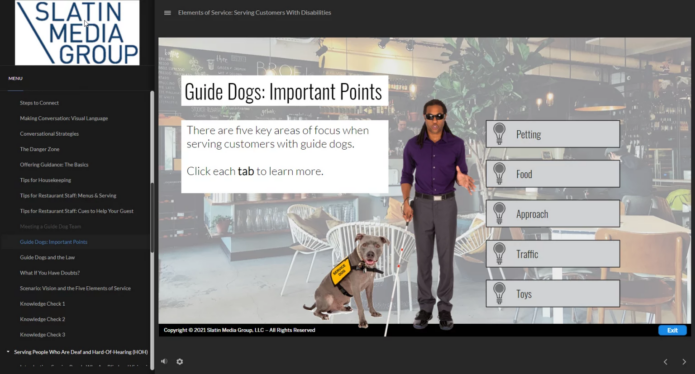
After working with dozens of hotels and thousands of workers across the country, Slatin realized he could reach more people with an online course. Joining forces with instructional designer and e-learning development expert Jason Willensky, the pair formed Slatin Media Group to launch their course Elements of Service. The scenario-based 45-minute class outlines strategies and best practices for staff in the service industry to excel when interacting with customers with physical disabilities.
Slatin shared the benefits of making accessibility a priority and actionable steps that restaurants can take now to ensure they’re providing stellar hospitality for all.
Three Steps Restaurants Can Take to Make Themselves More Accessible
1. Find A Designer Who Understands Accessibility
“Accessibility should be one of the design drivers for your restaurant rather than an afterthought,” says Slatin. “It should be thought of as not an obstacle to good design, but something that bolsters good design.”
Start by looking beyond the wheelchair ramp.
- Do you have enough tables that can accommodate those who aren’t comfortable with or can’t sit at a high top?
- Are your indoor and outdoor pathways wide enough for a wheelchair and clear of physical barriers?
- Do you have a menu that’s accessible for those with visual disabilities?
- Do you have a quieter spot where the deaf and hard of hearing can communicate more easily during their meal?
These small changes can make a world of difference.
2. Update Your Digital Spaces
Slatin uses a screen reader to read menus online for takeout and delivery. “If a website is not coded, designed, and programmed so that a screen-reading software can interact with it properly, I won’t be able to use it,” explains Slatin. “Not only is this illegal under the ADA, but it means I’m going to take my business elsewhere out of necessity.”
3. Practice Social Accessibility
“Social accessibility can be defined as how your staff interacts with people with disabilities or someone who they feel uncomfortable about initially,” explains Slatin. “You can have all the physical and digital access there, but if you’re treating guests poorly, snubbing, embarrassing, or just generally mishandling them, then none of the other measures will matter.”
Slatin Media Group’s Elements of Service aims to facilitate the discussions and knowledge needed to ensure your restaurant is socially accessible.
Three Benefits to Restaurants that Take the Steps to be More Accessible
1. Boost Business
“[Over one in four adults] has a disability of some kind,” explains Slatin. “The aging population of baby boomers will increase these numbers, and speaking from experience,” Slatin jokes, “Us spoiled boomers will still want great service and will go to where we can get it.”
In addition to the growing older population, today’s younger people with disabilities are more empowered and active than generations before. With better jobs, they are eager to spend their disposable income at establishments that respect them. “Once this community is aware that there is a place to go if you want good treatment, that will definitely affect your bottom line.”
2. Avoid Litigation
The Americans with Disabilities Act outlines specific requirements for businesses to stay compliant. “There is the risk of lawsuits and legal action of all kinds if you’re not meeting the requirements,” warns Slatin. “The majority of my clients come to me after they’ve already been sued, but it would be great if they thought to reach out beforehand.”
While physical changes like wheelchair–accessible ramps and compliant bathrooms are widely known, digital accessibility for a restaurant’s website and online presence is a new frontier that has led to thousands of lawsuits filed each year.
3. Support Those in Your Community
“The main benefit to the operator is, of course, that they are welcoming a population that has historically been underserved, and that’s a polite word for it,” says Slatin. If your staff is better prepared to work in coordination with those with disabilities, your team will be more comfortable, confident, and welcoming.
Ultimately, Slatin says, “people with disabilities should be everywhere throughout your organization, both as customers and as employees. There are steps you can take so everyone feels informed, comfortable, and prepared, enabling your team to deliver quality service to all. If you can remove and diminish barriers, you’re going to make life in the restaurant smoother for your staff and customers, avoid disruption, and lessen the possibility of legal action.”