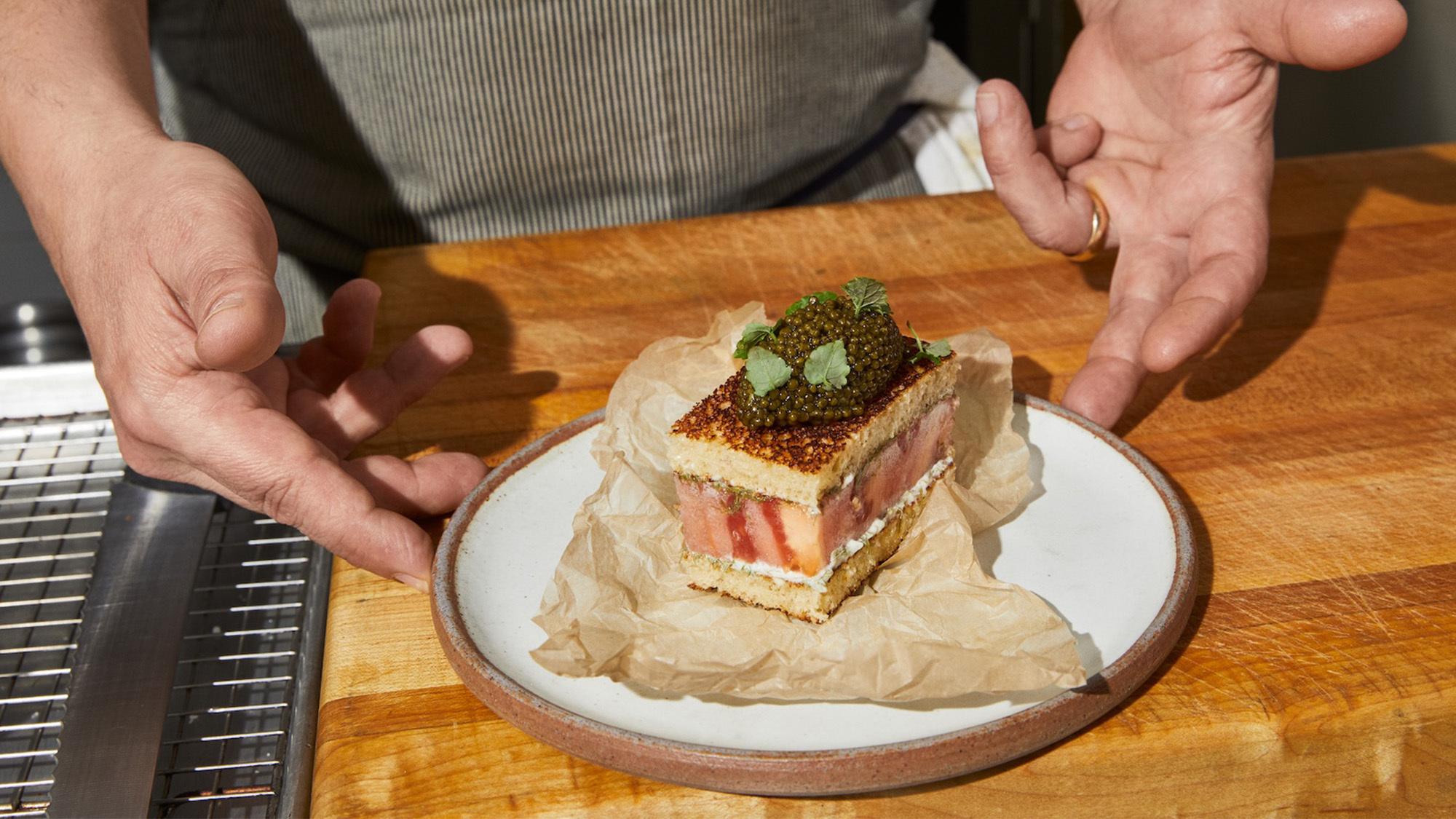
Why River Twice’s Heirloom Tomato Sandwich Is the Dish of the Summer
Published:
East Passyunk’s River Twice takes its name from a proverb coined by the ancient Greek philosopher Heraclitus: “A man never stands in the same river twice.” The axiom is indicative of chef and co-owner Randy Rucker’s guiding principles: spur-of-the-moment creativity and fidelity to local and seasonal ingredients.
“The creative process starts, for me, with the availability list,” says Rucker, a Texas native and multiple James Beard Foundation nominee. Rucker cooked at restaurants in the Houston area and on Martha’s Vineyard before opening River Twice with his Philadelphia-native wife, Amanda, in 2019. “I’m a big believer in having an intimate relationship with our food source, whether it be fishermen or ranchers or people growing our rice or whatever it may be. The Philadelphia area, within 150 to 200 miles, has pretty much everything that a chef needs to be happy.”

Rucker’s somewhat spontaneous approach to putting together River Twice’s four-course, seafood-focused dinners means that he rarely does the same thing twice. “I’ve always had a thing about no repeat dishes,” he explains. “I don’t have a big book of ideas. I don’t write anything down. We kind of just cook.”
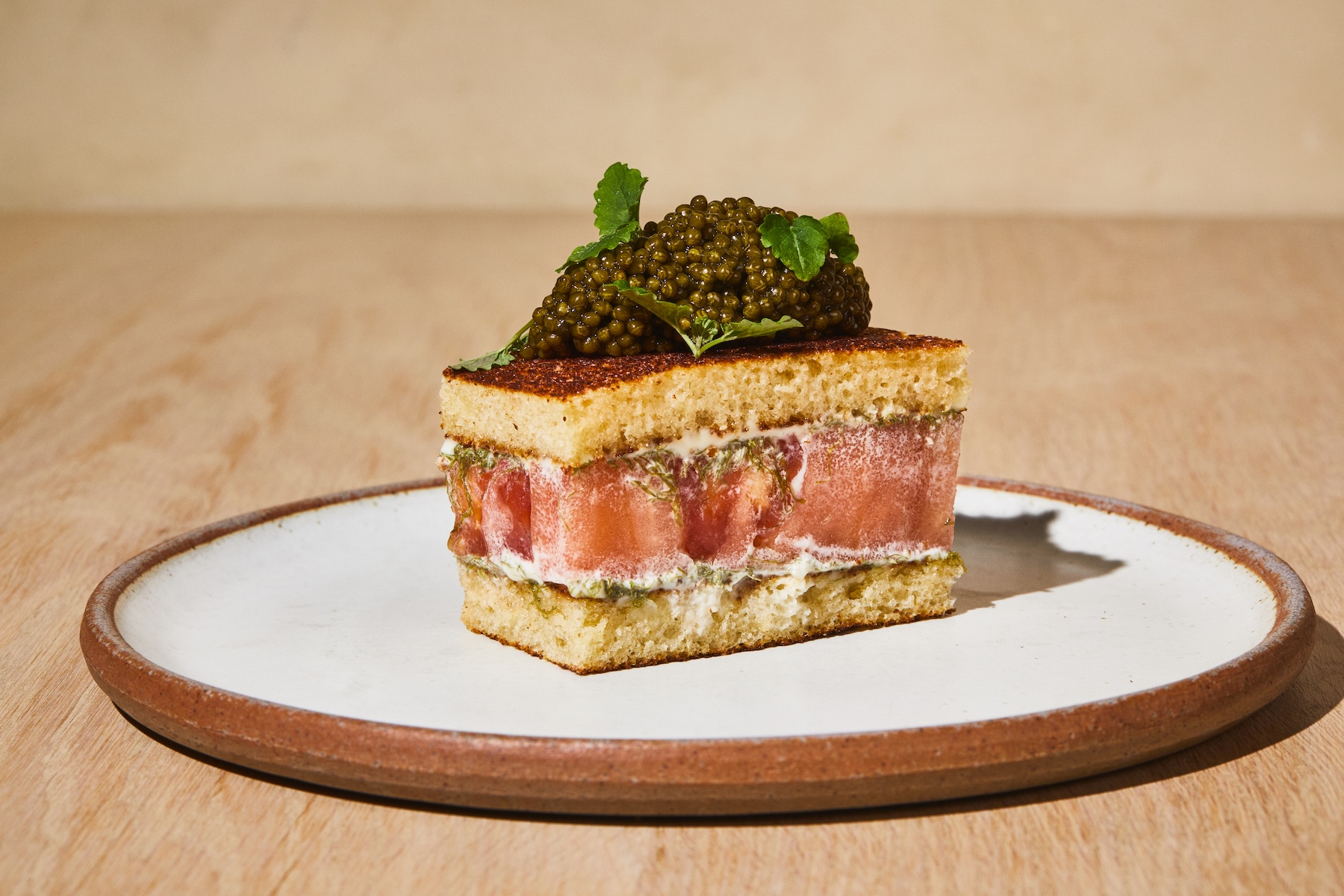
Every once in a while, though, a moment of genius is so pitch-perfect that it can’t remain simply a one-off. Such is the case with the heirloom tomato sandwich, which has become a summertime staple at River Twice year after year.
“I think it was just one of those things where, one day, we had some really nice tomatoes that came in, and someone said, ‘Oh, I love tomato-mayonnaise sandwiches,’ and we built on it from there,” Rucker recalls. “It really is just a tomato sandwich, but it couldn’t be farther from just a tomato sandwich. It’s a perfect personification of what we do at River Twice: We take our craft very seriously, we take our jobs seriously, but we don’t take ourselves very seriously.”
It really is just a tomato sandwich, but it couldn’t be farther from just a tomato sandwich.
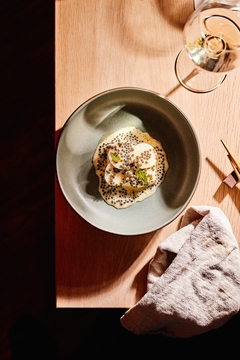
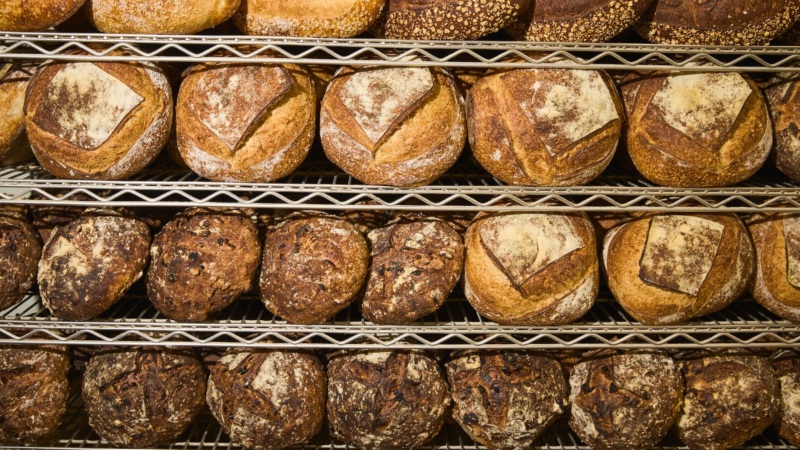
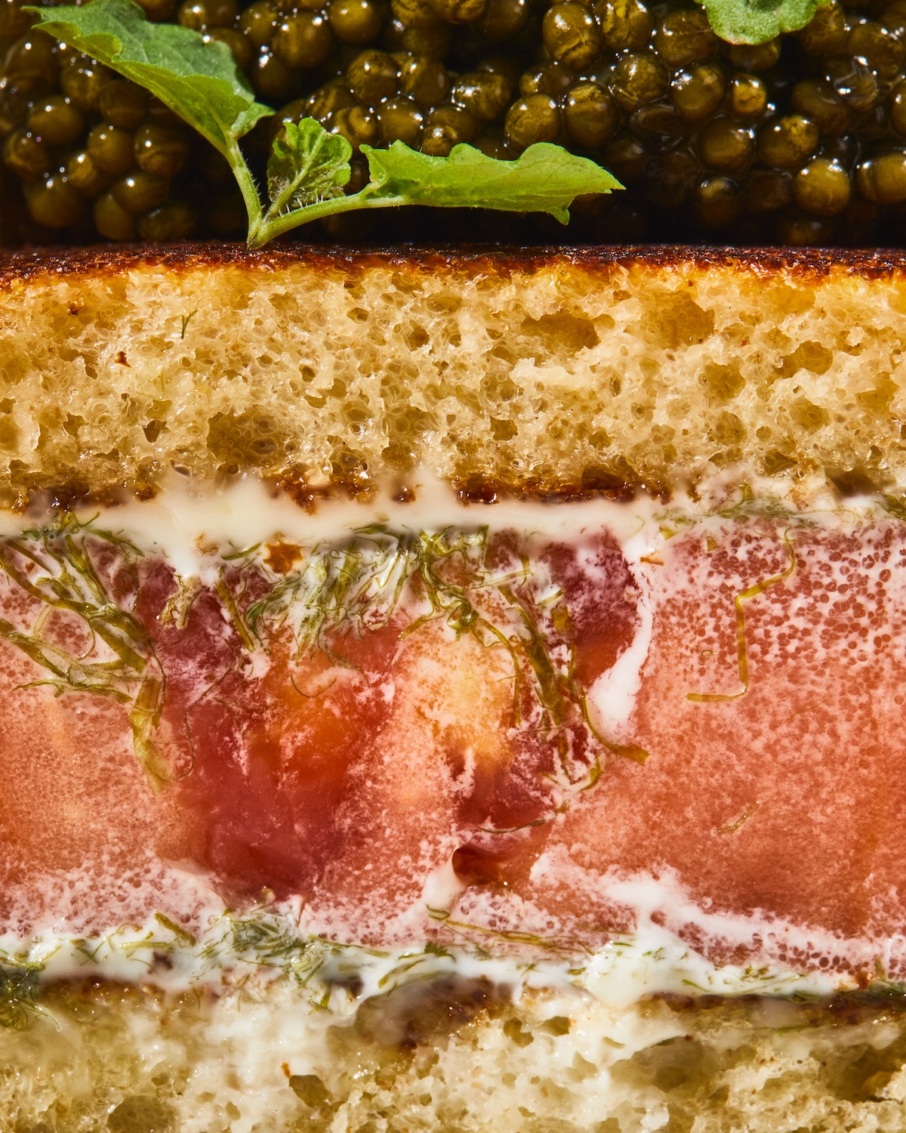
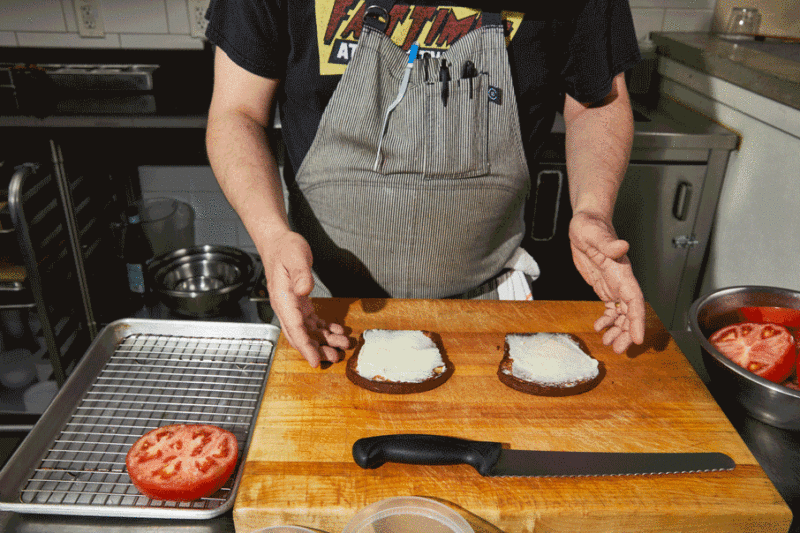
The sandwich, an optional addition to the tasting menu during tomato season, starts with sourdough brioche from nearby Mighty Bread bakery. The slices of bread are toasted dry on both sides on a flat-top griddle, and then spread with smoked mayonnaise. “I’m a diehard Duke’s fan,” Rucker says, “so we just buy Duke’s mayonnaise, and we smoke it with applewood, so it takes on a smoky, bacon-esque flavor.”
Of course, then there are the tomatoes themselves. Rucker sources from rotating area farms (Urban Roots Farm, Hill Creek Farms, and Lancaster Farm Fresh), using a wide range of varieties, and cuts into three-quarter-inch pieces, which he seasons simply with Henlopen sea salt from Delaware. “We try not to refrigerate them, so they’re extremely juicy,” he explains. “It’s a great way to celebrate the variety of different tomatoes that we see throughout the season, almost on a microclimatic level. It’s about having that relationship with the farmers and knowing what’s coming up: Hey, the purple Cherokees are ready in two weeks, the zebras are ready this week. So, it’s a sandwich that kind of changes along with the season.”
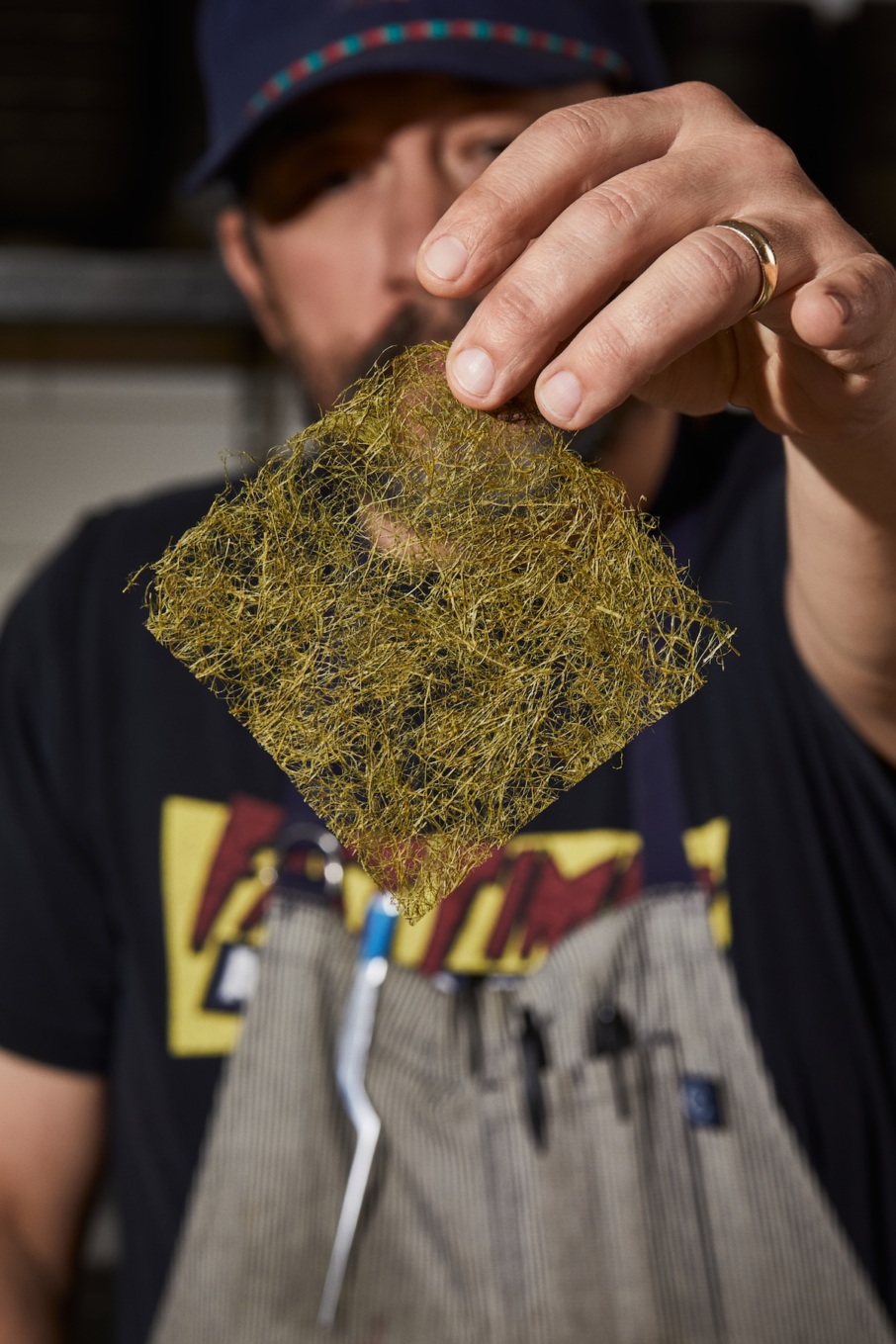
Not everything is local, though. In particular, two imported ingredients raise the sandwich from its down-home roots. The first is a thin sheet of gamtae, a type of Korean seaweed that Rucker says is “really smoky” and adds “loads of umami.” “We probably eat most of it when we buy it, to be honest with you,” he adds with a laugh. “It comes in sheets. They spray [the seaweed] on screens and as it dries, it has this cobweb-looking appearance, and we’re able to cut out perfect squares, the same size as the brioche.”
The coup-de-grâce is a generous heap of golden Osetra caviar plunked right on top. “It’s a very generous portion of caviar, probably close to one-and-a-half ounces per sandwich,” Rucker notes. “It creates this really amazing unctuousness to it, and makes it luxurious and sexy and fun to eat.”

Unsurprisingly, given the extravagance with the caviar, the sandwich isn’t the most affordable. It costs around $50 — although Rucker estimates that the caviar alone “is worth probably $60, $70.” It also takes a fair amount of precision to get it just right.
“To be honest, this sandwich has taken out cooks before,” Rucker says. “We have to let the toast rest on a rack for at least 90 seconds, because if it’s too hot, then the mayonnaise doesn’t stick, or it steams the tomato. You have about two or three minutes from when you season the tomato and the guest gets it, or else the tomato starts to cure, and the water starts leaching out. If you press too hard when you’re cutting it, the mayonnaise will come out. And I’m a little particular about it. It’s a $50 sandwich — it has to be executed well.”


The finished product, sliced in two with its crusts trimmed, has become a River Twice trademark. “We don’t serve one where someone doesn’t giggle when it hits the table,” Rucker says. “People will come in and order two and three. It’s definitely a thing in the city. It’s fun, it’s a great way to break into the summer, and it’s a great way to end the summer.”
The last question, as with almost any lavish restaurant sandwich, is the dilemma of using your hands versus utensils. To this, Rucker says, “I definitely advise guests just to pick that s—- up and get it in you.”
River Twice is open Friday through Monday from 6 to 10 p.m.
Justin Goldman is a Brooklyn-based writer covering travel, culture, food, and wine. A former editor at Hemispheres, he contributes to Condé Nast Traveler, Wine Enthusiast, the Los Angeles Times, and Eater. Follow him on Instagram.
Aaron Richter is a Philadelphia-based photographer who has shot for The New York Times, Esquire, The Times of London, and many other outlets. He also hosts “A Shot” podcast. Follow him on Instagram. Follow Resy, too.