The Story Behind Sorellina’s Most Iconic Pizza
Published:
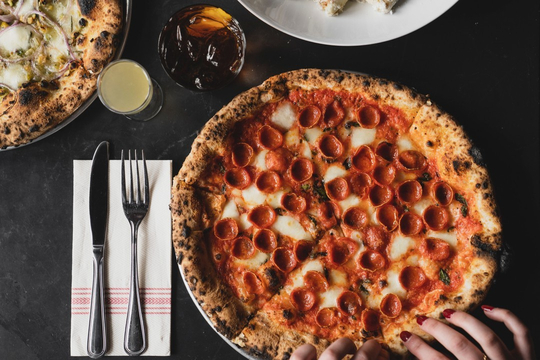
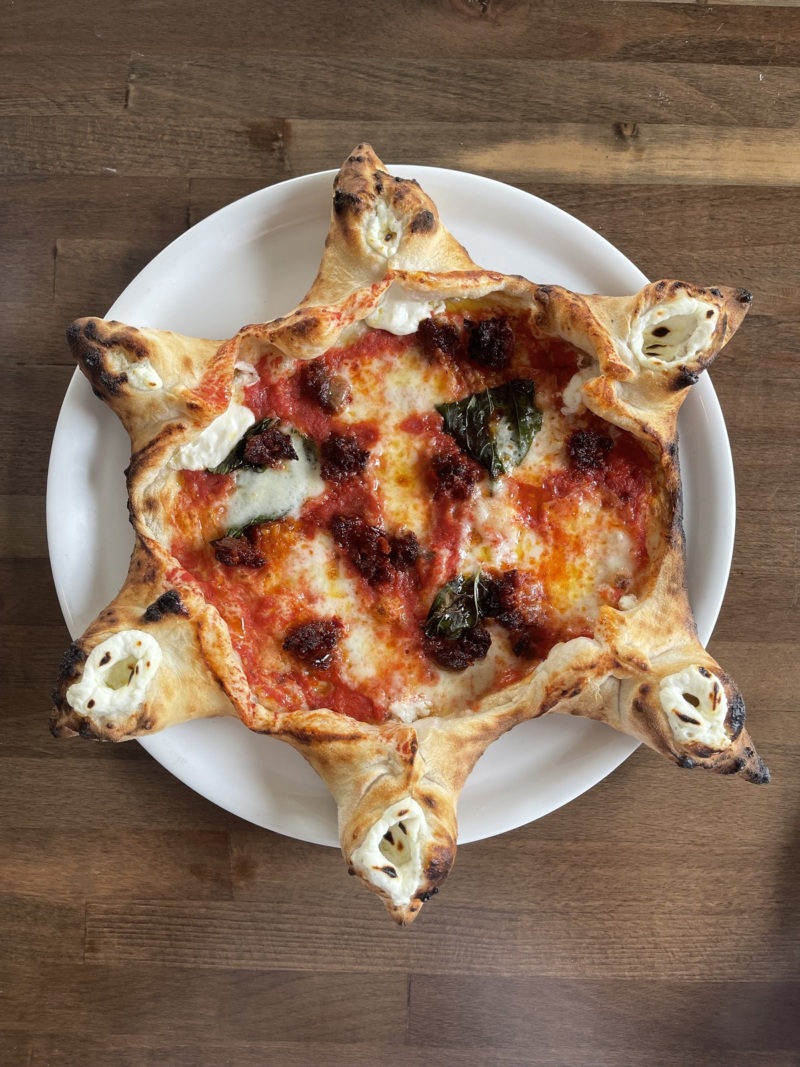
It’s a Sunday afternoon, and I’m standing in a prep kitchen on the ground floor of the Divine Lorraine Hotel, a few blocks south of the Met on North Broad Street. I’m here to learn how to make a pizza I’ve been craving since my first bite of it more than a decade ago: the “Stella.” This light, crispy, star-shaped pie with a ricotta-stuffed crust and crushed tomatoes, spicy ’nduja sausage, and mozzarella on top is the brainchild of chef Joe Cicala.
To me, and arguably, many other Philadelphians, it’s an iconic pizza all its own, a contemporary classic: soft in the middle, with a lighter, more raised, fluffier dough, a thin, crispy bottom, and a chewy bite. And it’s been a fixture on Sorellina’s menu since the restaurant opened in 2024, just across the hall from Cicala’s Southern Italian restaurant, Cicala at the Divine Lorraine.
Last year wasn’t the first time that Philadelphia saw star-shaped pizzas like this, however.
For three years, Cicala made them at Brigantessa on East Passyunk, now home to Ember & Ash, but when Brigantessa closed at the end of 2019, those star-shaped pizzas disappeared. In the near-decade since, Philadelphia’s pizza scene has evolved tremendously. It’s a serious pizza city without any singular defining style or pie, home to well-known establishments like Pizzeria Beddia, Angelo’s, Pizzeria Stella, and Spuntino’s.
Davide Lubrano Lavadera, chef and co-owner of Pizzata Pizzeria in Fitler Square and Pizzata Pizzeria & Birreria on East Passyunk Avenue, thinks Cicala deserves more credit for raising the art of pizza-making locally.
“Being a pizzaiolo from Naples, Italy, myself, I believe the reason why Joe’s pizza is special is because of his true understanding and commitment to the craft,” Lavadera says. “A true authentic Neapolitan pizza is hard to find anywhere in Philadelphia right now.” When Lavadera craves a taste of Italy, he heads to Sorellina.
Scuola Italiana Pizzaioli instructor and long-time International Pizza Expo judge Gregorio Fierro also gives Cicala credit for holding down tradition.
“When I’m teaching or consulting, I don’t try to reinvent pizza, and I think Joe is similar to that as an operator; he’s trying to make the best possible version of a very traditional, classic product,” says Fierro, who works with local pizza entrepreneurs like Angelo’s, Del Rossi, Eda’s, Dough Head, and more.
Chef Brad Daniels of Tresini Bar & Cucina in Ambler, Pa., believes Cicala remains singular in his old-world style of pizza-making.
“Joe stands out because he’s pulling from old-school techniques — his style is definitely harder, takes longer, but he’s doing it right,” says Daniels. “Balanced ingredients, the perfect chew with char, and a super bubbly, airy crust.”
It’s a tedious process that pays off: In 2021, Cicala’s Neapolitan pizza won third place at the International Pizza Expo.
Sorellina’s Pizza
By the Numbers
-
Average number of pizzas sold each night
150 on weekdays, 300 on weekends -
Days required to make the dough
3 -
Number of pizzas simultaneously baking in the oven
6
-
Average time it takes to cook one pizza
90 seconds -
How many pizzas a single batch of dough yields
Roughly 60
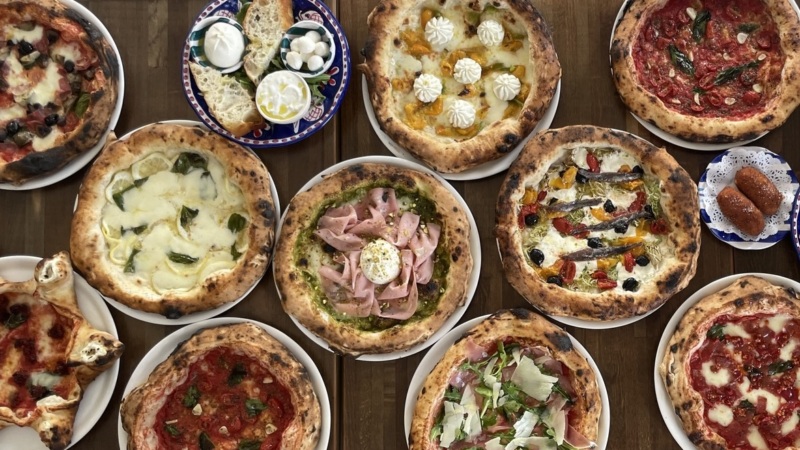
Pizza dough has just four ingredients — flour, water, salt, and yeast — but the process of making it is much more complex. At Sorellina, the dough is made fresh nightly and takes three days to complete, with nearly every step done by hand, from portioning and scaling to stretching.
Cicala began his pizza career training with chefs in Naples, Italy. In 2013, he learned the official method of making Neapolitan pizza by completing the True Neapolitan Pizza Association (AVPN) certification process, and while he draws from that foundation often, he isn’t afraid to experiment.
Unlike the “direct method” pizza dough recipes documented in AVPN’s official cookbook, Farina Acqua Lievito Sale Passione (peep it on Sorellina’s shelves), Cicala starts with a 24-hour pre-ferment called the biga — a high-hydration, high-protein flour mix he learned about from younger chefs in Napoli. The biga rests in the cooler for a day before being tossed into a large mixer, where ice cubes, cold water, and salt are slowly added to create dough.
Neapolitan-style pizza dough is typically hydrated to somewhere between 60% and 70%. Cicala opts for the high end of that range, even though it requires more careful handling. “You get a lighter, fluffier, slightly crispier crust, which I think is great for the Stella because it’s such a rich pizza,” adds Cicala. He also cites the “canotto” crust of Neapolitan pizza as a quintessential characteristic — the airy, puffed-up crust edge that looks “inflated like an inner tube.”
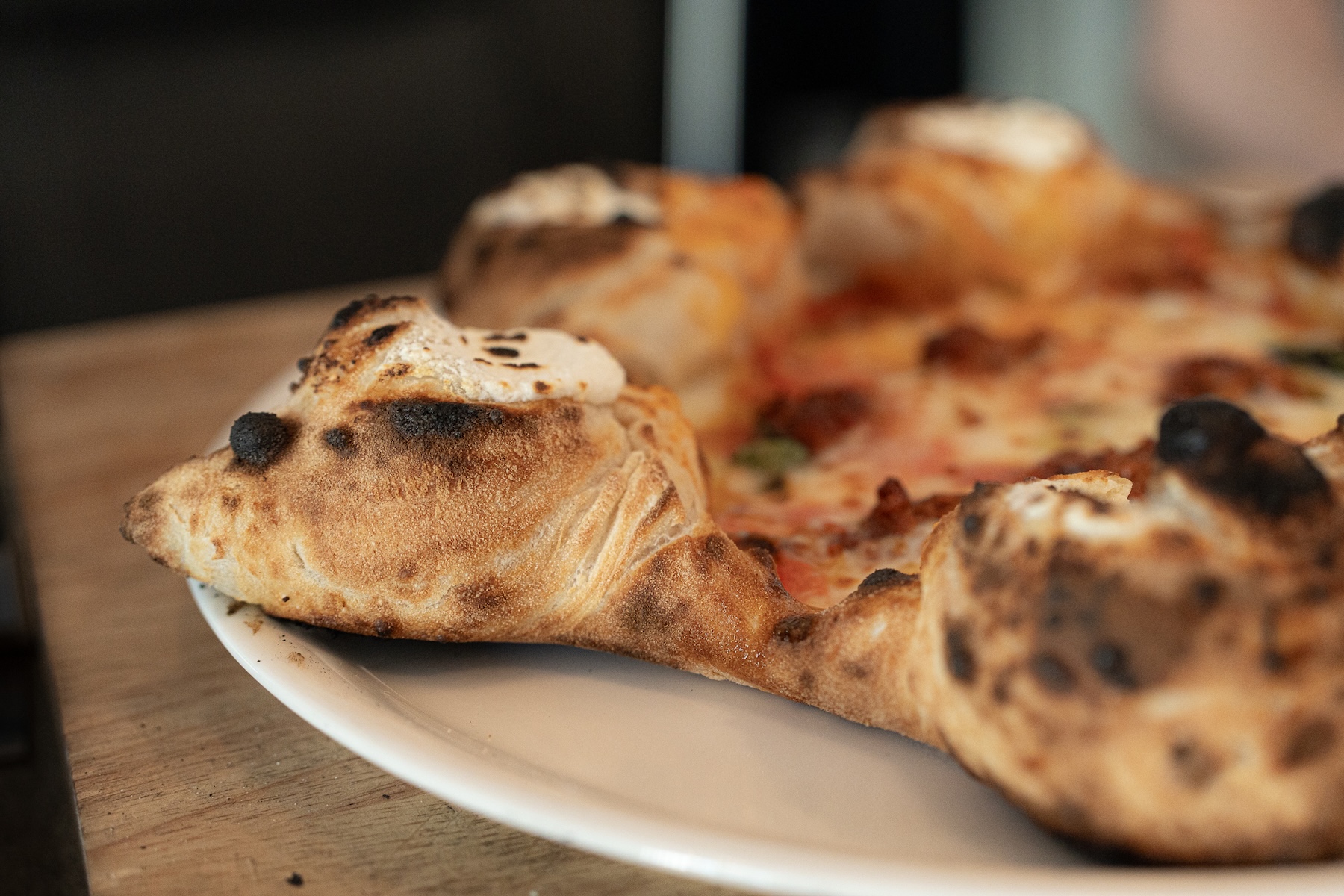
The Stella is a variation of a pizza served on Fat Tuesday during Carnival season. “It’s like your last chance to eat something very rich before Lent. I thought the concept was so cool — a star-shaped pizza and the crust is stuffed with ricotta,” Cicala says.
His vision for Sorellina was to replicate the Neapolitan pizza-eating experience. “It’s authenticity above everything,” Cicala says — so the Stella remains close to the original version. However, instead of a bunch of meats on top, he opts for ‘nduja from Calabria and mozzarella from grass-fed cows in the Lattari mountains backing the Amalfi coast.
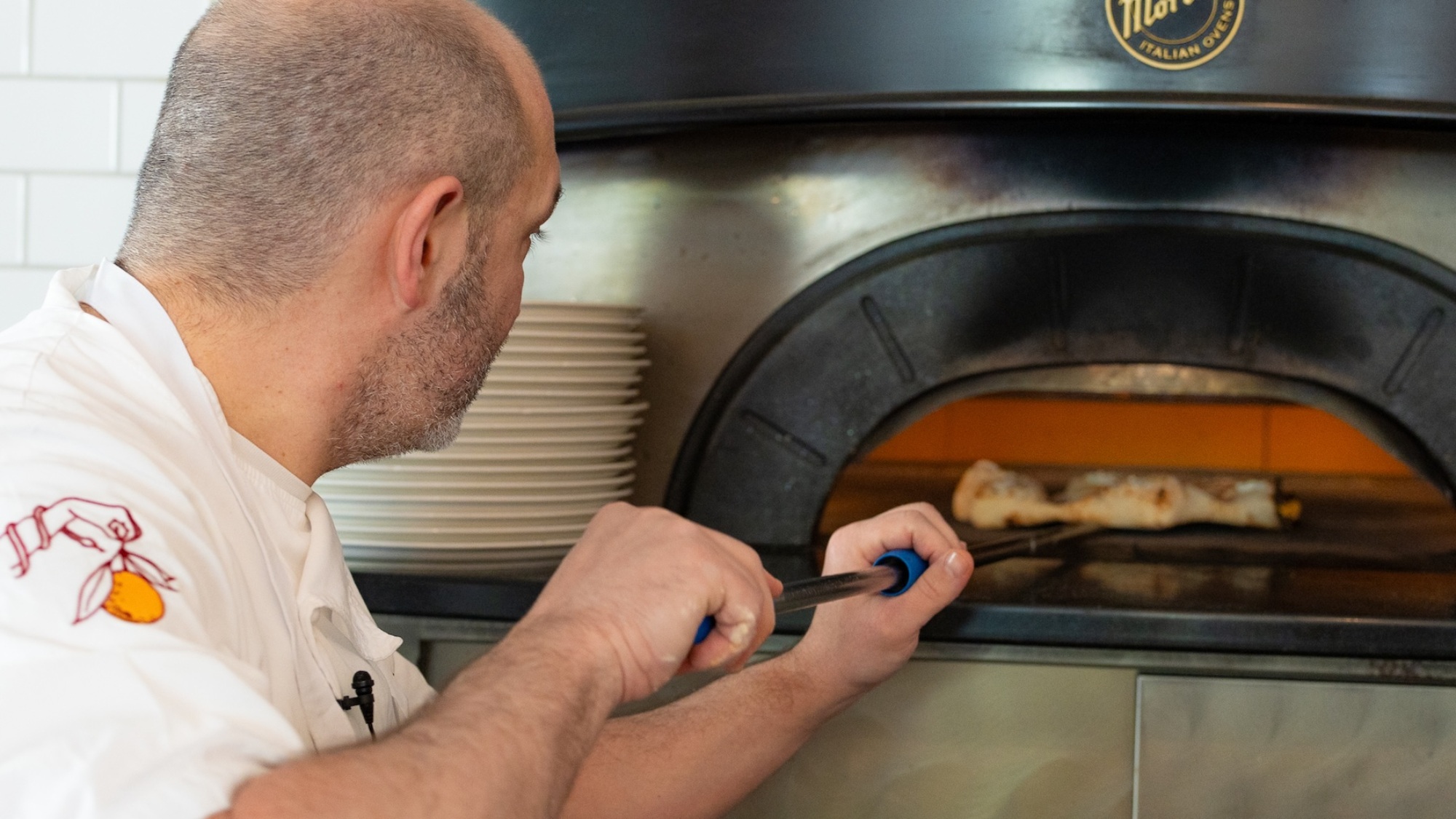
While Neapolitan pizzas are typically baked in a wood-fired oven, the historic Divine Lorraine Hotel building code restraints called for Cicala to trade in his Gianni Acunto wood-fired oven for an electric one. Many of Cicala’s Italian chef friends were experiencing the same issue working in historic venues, so they collectively turned to Moretti Forni Neapolis for electric versions of their Neapolitan ovens.
“I love it. It’s turning out the same product,” says Cicala, who doesn’t believe wood-fired ovens add flavor beyond smoke. It also allows for consistent temperature control (up to 1,000 degrees, no less), reduces unpredictability, and is easier to train staff to use, all without compromising pizza quality.
Like a traditional Neapolitan oven, Cicala’s electric Neapolis has a lower, shorter door, or dome, and works like a deck oven. He sets the temperature to 485 degrees Celsius (that’s 905 degrees Fahrenheit) and begins to build the Stella.
Cicala shapes the dough into a round, 12-inch size using the slap method before making five slits (picture 12, 10, six, four, and two on a clock) which will become the star points. “I like to have the fancy shape exposed for each of the points.” Then he pipes on fresh ricotta in between each slit, pulls the dough to wrap around the cheese, and pinches it together.
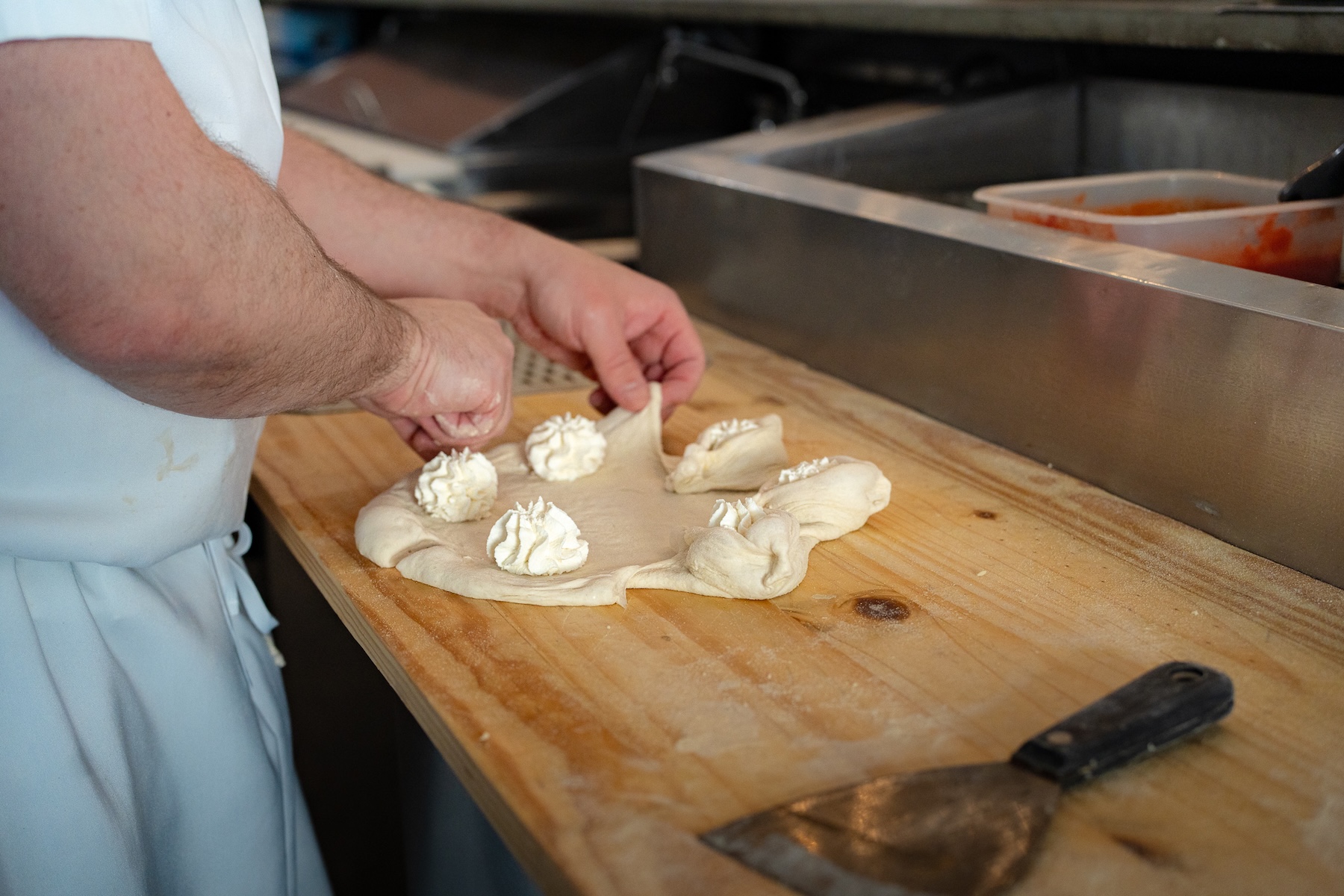
Staying true to Italian culture, he prioritizes quality ingredients like DOP (protected denomination of origin) products, seasonality, and minimal toppings to highlight the dough’s flavor. “I build the pizzas upside down as far as toppings are concerned, because I like that the cheese melts over top of it and prevents it from burning or charring,” Cicala explains. First, he ladles on San Marzano crushed tomatoes “straight out of the can — no basil, no garlic, just salt” and spreads it across the middle of the pie. Then, he layers on ‘nduja, a few basil leaves, and shoestring strips of Fior di Latte from Latteria Sorrentina, which “has an amazing melt and stretch” he says.
Then, the Stella is off to the oven to cook. Patiently waiting, I hear it sizzle and follow Cicala’s pizza oven movements, which, by now, are intuitive. “Put the pizza exactly where you want it to be in the oven, and then with one motion, pull straight back,” he says.
When checking on the pizza in the oven, “go in from the side and lift slightly. Pull it forward and then push it back.” Cicala cooks the Stella towards the mouth of the oven until it rises, then moves it towards the back to crisp off. “Have confidence,” is his ultimate advice.
About two minutes later, the star tips have puffed up, the ricotta cheese is slightly gooey, those signature “leopard spots” cover each point, and the tomato sauce and cheese have merged with the ‘nduja in between. Cicala drizzles on extra virgin olive oil before plating the pie and serving it whole.
Sorellina’s pizzas are personal-sized, pleasantly floppy, and molten cheese-studded, all of which invites the use of a fork and a knife. Still, a pizza cutter is offered to guests who want to slice their own. “We get a lot of Italians here, so they want to eat it that way and cut it themselves,” says Cicala.
I grab a slice and am taken back to my first bite at Brigantessa, the restaurant where Cicala debuted the Stella all those years ago. It’s a bit of a mess to eat, but the light, crispy pizza is still one I’d happily crush by myself any day.
Sorellina is open for dinner Wednesday through Saturday from 4:30 to 10:30 p.m. and on Sunday from 4:30 to 9 p.m.
Alisha Miranda is a food and travel journalist and #LatinxIndustryNight cultural producer based in Philadelphia. Follow her at @alishainthebiz. Follow Resy, too.