An Insider’s Guide to the Finger Lakes
Updated:
Throw a dart towards the middle of a New York State map and it likely will hit one of the Finger Lakes. The digit-shaped lakes that run north to south between the cities of Rochester and Syracuse are the geographical center of the Empire State. They’re also the beating heart of northeast wine production, with over 140 wineries dotting the hillsides of four of the major lakes.
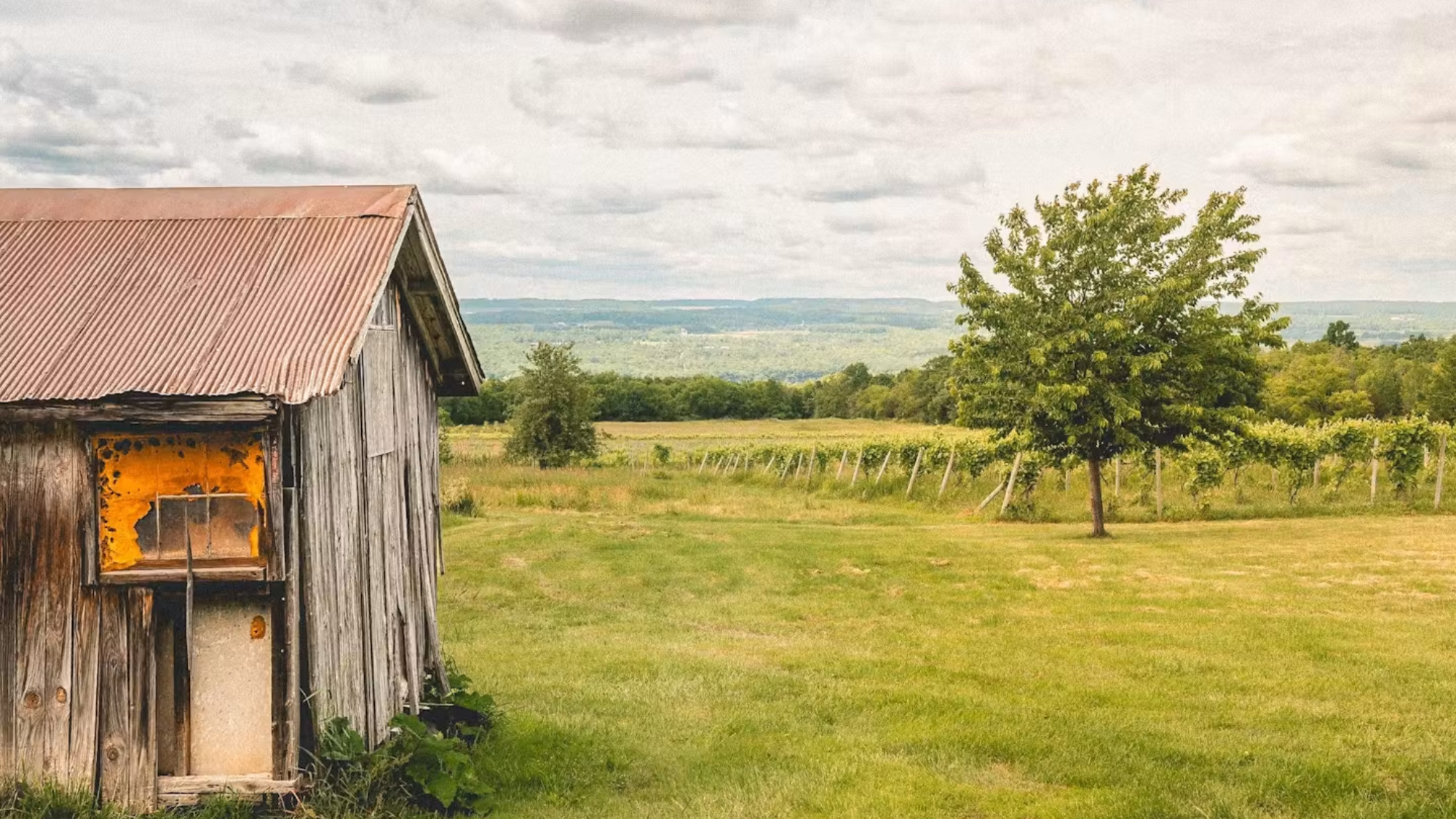
A land of rolling hills that tumble into deep, narrow lakes dotted with patchwork quilt squares of grapevines, apple orchards, soy, corn and wheat fields, flanked by postcard-red barns and grain silos; waterfalls that thunder into dramatic gorges amidst dense stands of maple, beech and oak trees.
Grapevines have been cultivated commercially in the Finger Lakes for the last 200 years. The mid-19th century saw the region soar to international acclaim for its sparkling wine; the last half-century has seen it rise again from the ashes of Prohibition to become the riesling capital of America — although its tale neither begins nor ends there.
The Finger Lakes region is deeply agrarian, and, like any rural American community worth its salt, it has a hillbilly side, a fond assertion I can defend, having grown up in the 1980s and ‘90s on the region’s eastern edges in a house where my parents still reside. The first day of hunting season was practically a holiday; there was an unofficial “drive your tractor to school” day; the Chinese take out joint was as close as we got to unexpected cuisines; and the local wines came mostly sweet and in a jug.
These days, a lot has changed — yet nothing has changed. The rod-and-gun club is still there; so is the speedway where I watched monster truck rallies as a kid. (Bonus: it now boasts an adjacent “Dirt Hall of Fame”). Tractors and manure piles from cow-crossings at nearby dairy farms are routine obstacles on the roads. But at the end of your drive, you might find yourself in the town of Geneva, at the northern end of Seneca Lake, enjoying a local sparkling saperavi beside spicy sambal chicken in a world-class wine bar (Microclimate) or perusing the shelves of a boutique wine shop (Aszú Wines & Spirits). Or perhaps stocking up on riesling and dumplings at Kemmeter Wine’s tasting room and not-so-secret dumpling shop further down the lake. Or indulging in local charcuterie and pink-pét-nat in Living Roots’s modern light-filled tasting room, with its glorious views of Keuka Lake.
The modern-day Finger Lakes cater to a wide audience, which, if anything, is an essential part of the region’s appeal. The sweet jug wines – now mostly in slushie form – still flow for thirsty throngs in warmer months. Riesling geeks make their pilgrimage to consider the variety that brought this region acclaim. But these days there’s a Finger Lakes wine for everyone — whether sappy cabernet franc, red-fruited blaufrankisch or chardonnay-based bubbles.
The Lay of the Land
Your gut might tell you the Finger Lakes are too cold to make wine. I get it. Growing up outside Syracuse, with its infamous title as the snowiest city in the U.S., it’s an easy conclusion. But the 11 narrow lakes that comprise the region have a few unique traits that allow grapevines to thrive. The clue is in the name: lakes.
Their formation began during the Devonian period, when sedimentary rocks — sand, silt, lime, mud and gravel, deposited by the mountain-building Acadian orogeny some 300 million years ago — hardened into layers that eventually formed ancient seabeds of limestone, sandstone and shale. Multiple uplifts between 200 and 100 million years ago transformed that into flatlands streaked by rivers until eventually, around 2 million years ago, the land was covered in ice. Glaciers advanced and retreated several times, each time depositing sand and gravel that dammed up those rivers, then gouged them deeper and deeper until, around 10,000 years ago (practically yesterday in geological time), the glaciers retreated for the last time, leaving their handiwork behind: 11 mineral-rich, extremely deep lakes.
The depth of the lakes play an important role in the Finger Lakes’s ability to successfully grow wine grapes–more on that in a moment–but let’s talk about the region’s continental climate.
Marketing shorthand for the Finger Lakes is “cool climate.” True, winters are long, snowy and often bitterly cold. The growing season is short. But the brief summers are hot and often oppressively humid, sometimes surging above 90F, with nighttime temperatures offering increasingly little relief. The region’s growing degree days–a cumulative gauge of growing potential–are actually closer to France’s Rhone Valley or Sonoma’s Dry Creek Valley than to Burgundy or the Mosel, Germany’s premier riesling-producing region. This heat explains why varieties like Cabernet Franc can easily ripen. It also explains the riper riesling style common here.
But back to the lakes themselves. Finger Lakes summers are hot, but they have the water on their side. Thanks to those powerful glaciers, the region’s major “wine lakes” are extremely deep. In fact, Cayuga and Seneca are two of the East Coast’s deepest lakes– 450 feet and 618 respectively at their deepest points. This means they rarely freeze, forming a blanket of warm condensation along their shores that protects vines from the region’s frigid winters. Their size and depth also help mitigate frost in the spring and autumn, thereby lengthening the growing season by several weeks. And they help to keep the vines cool in the sticky summer. So while the term “lake effect” is often bemoaned as the cause of a doozy of a snow storm (just ask anyone in Buffalo), in viticultural and agricultural terms, it is in fact the salvation of the wine landscape.
History In a Bottle
The Haudenosaunee people knew of the “lake effect” when they first settled the region 1,000 years ago and established sophisticated agricultural villages. Homesteading colonists knew it when, after the Sullivan campaign razed the Haudenosaunee towns during the Revolutionary War, they established a roaring apple trade from imported English seeds, surviving on hard cider, which was then cleaner than water. Wine growers knew it, from the early 19th-century farmers who cultivated native grape varieties like Catawba and Isabella (which, by the mid-1800s would produce the most acclaimed sparkling wine in America), to the Ukrainian, French and German immigrants who, after a nearly half-century hiatus due to a perfect storm of Prohibition, the Great Depression and World War II, picked up where their predecessors had left off.
But that postwar cohort wasn’t interested in American varieties. They were determined to cultivate the European varieties of their homelands, at the time thought impossible to grow in putatively frigid upstate New York. French winemaker Charles Fournier, who boasted Veuve Clicquot on his resumé, introduced the region to French-American crosses like baco noir, Leon Millet and seyval blanc. But it was the opportunity Fournier provided to Ukrainian immigrant Dr. Konstantin Frank that changed the course of history. He hired Frank as director of vineyard research at his Gold Seal Winery in 1954, allowing Frank to put his PhD in viticulture to use testing cold-hardy rootstocks grafted onto a variety of European vinifera, the varieties used to make fine wine. Frank went on to establish his own winery, Vinifera Wine Cellars (now Dr. Konstantin Frank Winery) in 1962. He planted up to 60 varieties in the name of research. To this day, cuttings of chardonnay, riesling, pinot noir and cabernet sauvignon from Frank’s original nursery are common in vineyards across New York.
Then, in 1976, came the state’s Farm Winery Act, which allowed small grape farmers, to make and market their own wines rather than sell to large corporations. The result was a boom of boutique wineries, like Glenora, Hazlitt and Wagner, plus one founded by an immigrant by the name of Hermann J. Wiemer. Wiemer, who hailed from Germany’s Mosel, planted riesling on his newly purchased land — 140 acres of former soybean fields on Seneca’s Lake’s western side. He proved, through careful viticulture, that his homeland grape variety belonged center stage — and would be the next to change the course of Finger Lakes wine history.
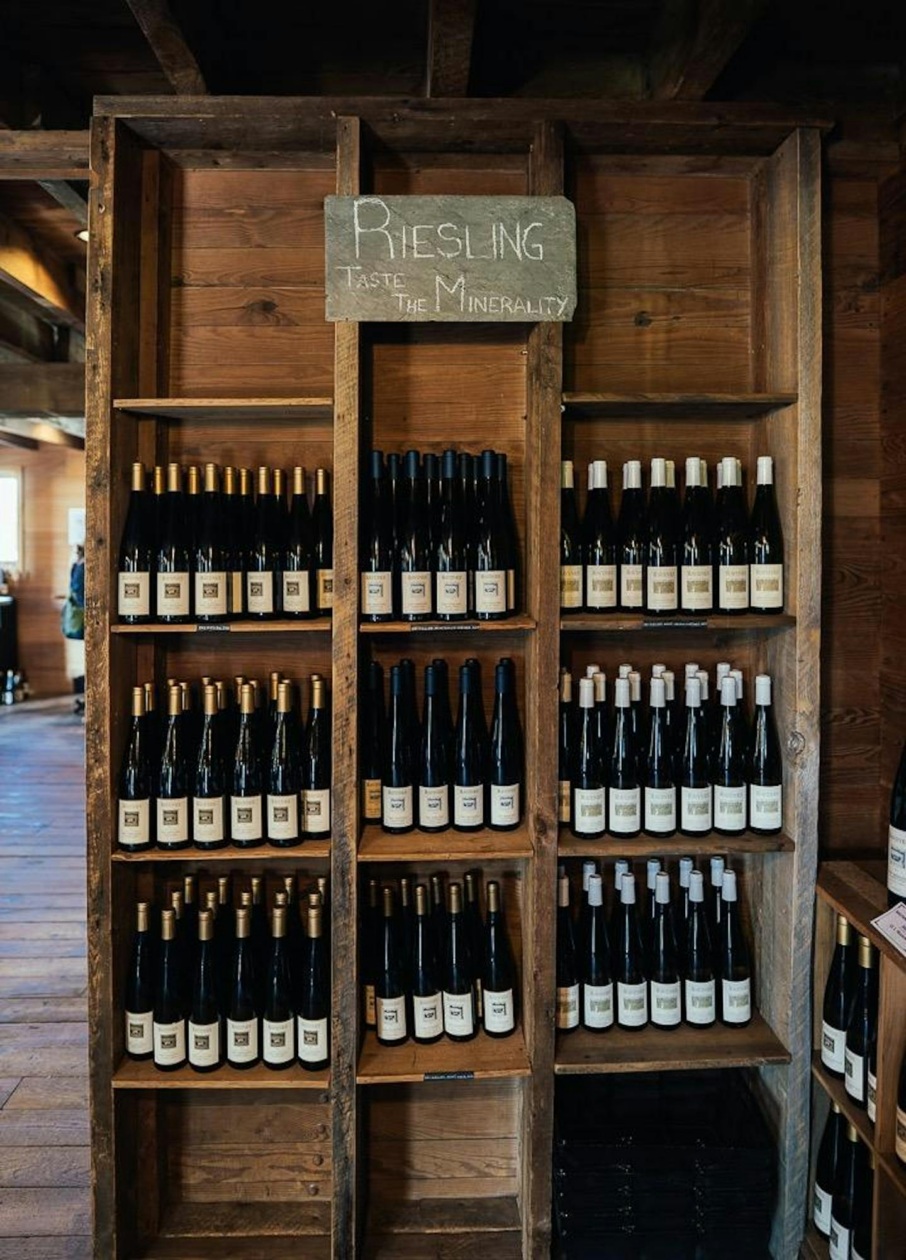
Today, riesling dominates the Finger Lakes, with over 800 acres planted (well over double the second most planted vinifera variety, cabernet franc, at 295 acres). Made in every style imaginable, Finger Lakes riesling tends towards natural fruitiness– peaches-and-cream with honeycomb and orchard blossoms thrown in– a plumper, more extroverted style than many tightly wound German versions, although a range of styles flourishes.
Wiemer remains one of the region’s top riesling producers (while also making blaufrankish, chardonnay and traditional method sparkling). As the Finger Lakes’s only certified biodynamic winery, and with a second label (Standing Stone, a longstanding property bought and transformed), Wiemer is arguably the Finger Lakes’ true benchmark producer today.
But the late 20th century and early 2000s brought a broader boom — and a new gaggle of quality-focused producers, including Fox Run, Lamoreaux Landing, Red Newt, Ravines, Red Tail Ridge, and Anthony Road. And the 2010s saw the rise of boutique wineries like Trestle Thirty One (the brainchild of Nova Cadamatre, America’s first female Master of Wine), micro-productions like Entelecheia, and hyper-site specific ones like Forge Cellars, founded by former New York importer Rick Rainey and Rhône Valley winemaker Louis Barruol of Saint Cosme.
The 2010s also saw the rise of the natural wine movement, and collaborations like Chëpìka, from winemaker Nathan Kendall and esteemed sommelier Pascaline Lepeltier. Their micro pét-nat label, made from American varieties Delaware and Catawba, brought renewed attention to long unloved non-vinifera varieties.
Today these “old” homegrown varieties, with more pét-nats and co-ferments made from hybrid and heritage American varieties–from tiny labels like Behemoth and Prism, plus bigger ones like Barry Family Cellars–than you could pop a crown cap at. They‘ve found a new audience, those too young to remember the “foxy,” “musky” pejoratives or sickly sweet efforts of earlier times. Cold-hardy natives and hybrids make a lot of sense in a world being shaken by climate change — and the quality of the resulting wines is ever-improving.
Indeed, producers like Osmote and Usonia, following in the footsteps of Bloomer Creek, who laid the groundwork for low-intervention winemaking in the Finger Lakes as far back as the 1980s, are crafting chillable reds from Marquette and crunchy whites from Cayuga White. The Little Clover winery focuses entirely on traditional method sparkling from Delaware and Cayuga grapes. These join a growing roster of side projects from established winemakers, like those of Echelon, from Wiemer’s Dillon Buckley, Vagabond from Hazlitt’s Alex Bond, and John Albert from Ravines’s John Monnier. And the Finger Lakes have proven to be one of the spots in the United States where the European vigneron model — being both farmer and winemaker — is economically feasible, as with Ria’s Wines and Apollo’s Praise, rising stars on opposite sides of Seneca Lake.
If You’re Going
To do everything wine-worthy in the Finger Lakes is impossible without a month to spare. It’s a sprawling region and a car is a necessity. Consider basing yourself on one of the three main “wine lakes,” Cayuga, Seneca or Canandaigua, and explore from there. (There are far more wineries on Keuka than Canandaigua, but accommodations are better on the latter.)
On the south side of Cayuga, Ithaca is a fabulously crunchy, colorful college town, home to Cornell University and Ithaca College, with more enchanting waterfalls than is fair for any small city (with a population of just 32,000, it is still the the largest city in the region), a charming pedestrianized mall, a solid food scene and ample lodging.
West of Cayuga Lake, Seneca Lake’s main hub is Geneva, another college town (Hobart, William Smith) at the northern end, with a treasure trove of 19th century architecture and a smattering of top-notch bars and restaurants, particularly along Linden Street. While less flush with accommodation options than Ithaca, there are some beautiful B&Bs and short-term rentals in the South Main Street Historic District.
And to the west of Seneca, Canandaigua Lake is the birthplace of Finger Lakes wines. While today it hosts only around eight wineries, it makes a good home base, especially if you’re flying into Rochester Airport, a 45-minute drive away. You can then reach many of Seneca and Keuka’s top wineries in 30 to 45 minutes from the historic town of Canandaigua, which also hosts New York Kitchen, a nonprofit that offers cooking and wine classes, and houses a tasting room featuring over 60 local wines.
Once you’ve chosen your home base, plot out a route — perhaps one lake per day. The roads are wide, picturesque and easy to navigate. (Perhaps too easy — local police are often out in force.) Also note: you’ll occasionally be sharing the road with Amish and Mennonite community members who have a significant presence in the area. Drive slowly around their horses and buggies, show them respect, and patronize some of their shops for meticulously hand-crafted goods and fresh-baked goodies.
Seneca Lake
To visit: Book a tasting flight in the atmospheric barn of Ravines, just outside Geneva, one of the region’s riesling bench-setters. Continue down the west side of the lake and stop in at Seneca stalwart Fox Run. Book one of their seasonal food and wine experiences. Anthony Road, Red Rail Ridge and Hickory Hollow (where the aforementioned Nathan Kendall operates from) are also of note. Hermann J. Wiemer is one of the region’s most important producers and is not-to-miss. Book in for a seated tasting, a private “library” tasting of multiple vintages, or, if visiting in autumn, a “harvest tour” for a peek behind the winemaking curtains.
Swing around the bottom of the lake through Watkins Glen (hike the 800 steps at the gorge to experience the majesty of the 19 waterfalls cascading over layers of glacial rock). Have a meal at Ryan William, one of the few FLX wineries to offer a full service restaurant (Ryan’s $19 pinot blanc recently took out the 2026 Food and Wine Classic trophy), or drive north up the east side of Seneca. Forge Cellars’s Swiss chalet-styled “Salon” is a great option, or head straight to Ria’s Wines. One of the most exciting vigneron projects of late, Ria’s beautifully textured white wines in particular are raising the region’s quality bar. Standing Stone Vineyards’s gorgeous views and approachable tipples can be enjoyed without a reservation, and a perfect foil to owner Wiemer’s more serious drops across the lake. Finally, try Lamoreaux Landing’s cab franc, the variety that put this longstanding producer on the wine map.
To eat and drink: In Geneva: Microclimate is the kind of neighborhood wine bar you never want to leave. FLX Table is a gem, too. In fact a bar crawl of the half dozen classy-but-welcoming watering holes that line Linden Street is a must-do when in Geneva. Take home a bottle of something special at Aszu Wine & Spirits just around the corner; grab a glass of from the excellent local-forward wine list at Kindred Fare on your way back from the wineries; or have high tea at Diciannove Dieci, the restaurant at Geneva on the Lake, a recently restored Italianate resort with beautiful lake views.
If you get peckish while winery-hopping, Two Goat’s Brewing, Sans Dumplings at Kemmeter Wines, and Tabora Farm & Winery, with its excellent deli and sandwich offerings, are all excellent pit stops.
Keuka Lake
To visit: Traverse the west side of this Y-shaped “crooked” lake to the birthplace of modern Finger Lakes wine, Dr. Konstantin Frank, then sweep up the east side of the lake and visit one of the newest, buzziest tasting rooms, Living Roots. Book a horseback ride through the vineyards, keep an eye out for one of their many seasonal events or just luxuriate in the stylish tasting room with a glass of 2025 blaufrankisch. Keuka Spring, at the northeast tip of the lake, just before the village of Penn Yan, has been recently renovated and offers an open-air cafe and tasting pavilion complete with breathtaking vineyard-meets-lake views.
Cayuga Lake
To visit: Drive up the west side of Cayuga Lake, stopping to snap pictures in front of Taughannock Falls or scarf a famous Pinesburger at Glenwood Pines. Or go east and visit Heart and Hands’s cozy tasting room to sample “alternative” varieties like aligoté and petite arvine, and elegant pinot noir. And of course, Cayuga is adjacent to Ithaca, so don’t miss your chance to buy an “Ithaca is Gorges” t-shirt on the Ithaca Commons, or hike Cascadilla Gorge Trail to Cornell’s campus.
To eat and drink: Buy a local bottle at the excellent Cellar d’Or wine shop. Experience the iconic Moosewood restaurant, one of the first eateries to popularize vegetarian cuisine in America. Alternatively, settle in at longstanding Ithaca institution Simeon’s or grab a pie at Pasty’s Pizzeria. Beat the crowds at the Ithaca Farmers Market. Indulge in coffee, carbs and cream at Collegetown Bagels, Gimme! Coffee, and Purity Ice Cream.